Let’s be honest for a minute.
If you run an industrial facility in Orange, California, your roof is quietly doing one of the hardest jobs on the property. It shields your production lines, inventory, machinery, and people from relentless UV, wild day-to-night temperature swings, and the occasional surprise downpour — all while getting walked on, drilled into, and loaded up with HVAC units, exhaust fans, and conduit. It asks for almost nothing in return. Until, one day, it stops cooperating — usually right over the one piece of equipment you cannot afford to have dripped on.
That’s the moment you start typing “industrial roofing contractor near me” into your phone at an hour when no reasonable person should be awake.
We’ve got you. This guide walks through everything you need to know about hiring an industrial roofing contractor in Orange — what makes industrial roofing genuinely different, what it costs when things go wrong, how the major roofing systems stack up, and why Applied Roofing Services (serving Southern California since 2003, with our office right here in the City of Orange) has become the team facility managers call when they want the job done once and done right.
Ready for a Free Industrial Roofing Estimate?
Call our Orange County office: (714) 632-8418
Or request your free estimate online.
The Real Cost of an Industrial Roof Failure
Let’s start with some uncomfortable math.
When an industrial roof fails, the leak repair is almost never the expensive part. The expensive part is everything the leak touches. A single water intrusion event over a manufacturing floor can mean damaged equipment, ruined raw materials or finished goods, slippery-floor safety hazards, and — the one that really hurts — unplanned downtime. For a working industrial facility, even a few hours of halted production can cost more than the entire roof repair.
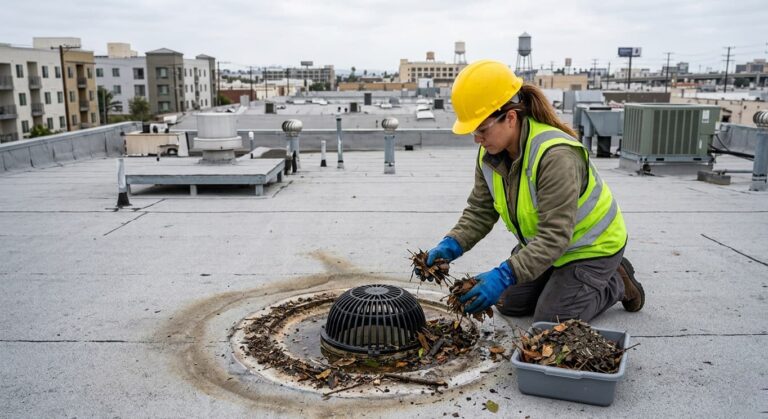
Here’s what makes it worse: most catastrophic industrial roof failures don’t happen out of nowhere. They build slowly — a blistered seam here, a bit of ponding water there, a flashing detail lifting at a rooftop unit nobody’s looked at in three years. Then one heavy Southern California storm rolls through, and a problem you could have fixed for a few hundred dollars becomes a five-figure event.
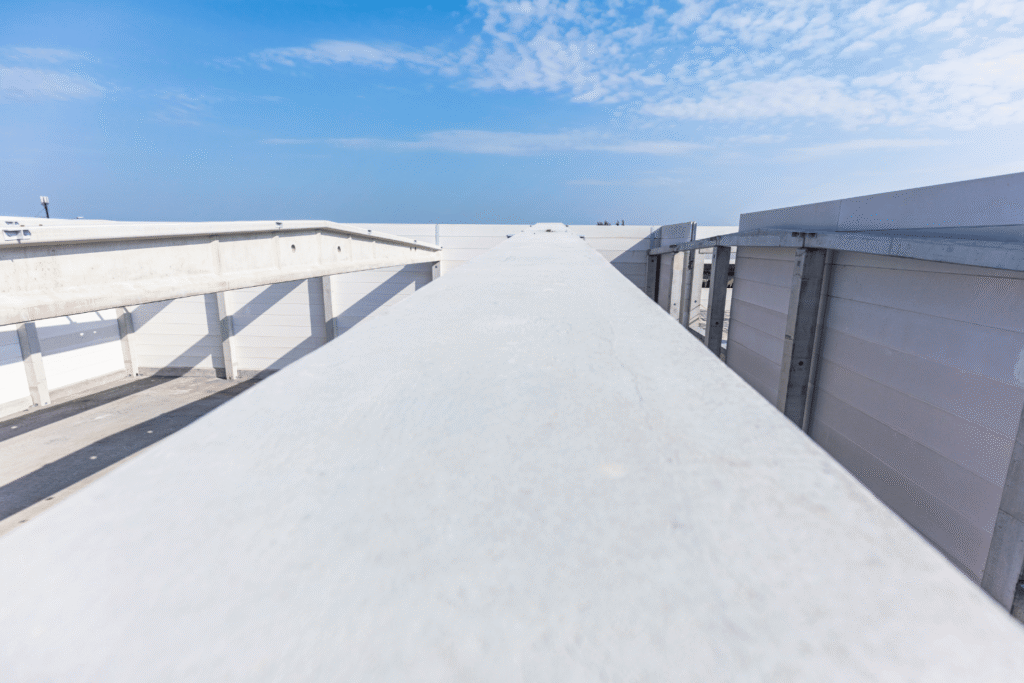
The hidden costs facility managers underestimate:
- Production downtime while affected areas are dried out, cleaned up, and cleared for safety
- Equipment and inventory loss when water finds electronics, motors, or stored product
- OSHA and safety exposure from wet floors, compromised electrical, or emergency roof access
- Insurance premium increases after repeated water-damage claims
- Emergency premium pricing when you’re forced to hire whoever’s available at 11pm instead of the right industrial roofing contractor at a planned pace
The takeaway is simple: proactively investing in the right roofing system, installed by a qualified industrial roofing contractor, costs a fraction of what you’ll pay cleaning up after a roof that was left to fail. It’s not an expense. It’s risk management with a return.
Why Industrial Roofing Is a Different Animal
Here’s something a lot of general roofers don’t fully appreciate: an industrial roof is not just a big commercial roof. It’s a different discipline.
Industrial buildings — warehouses, distribution centers, manufacturing plants, cold-storage and processing facilities — tend to have enormous roof areas, complex rooftop equipment, heavy maintenance traffic, and often chemical, grease, or heat exposure a standard office roof never sees. That combination changes everything about how the roof should be specified and installed.
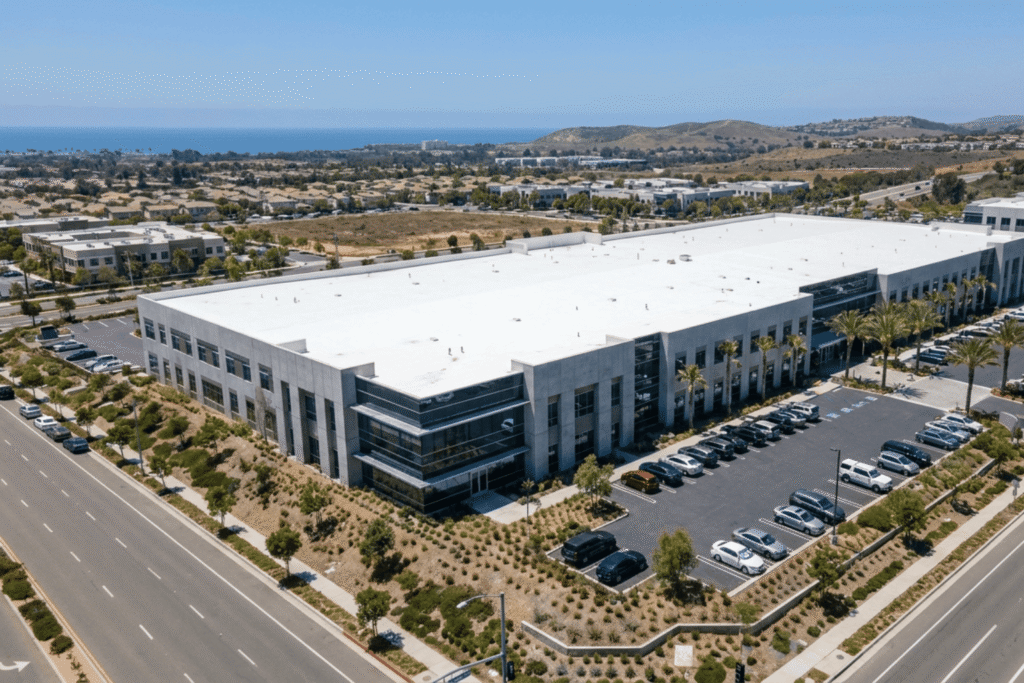
Scale changes the game.
A 5,000-square-foot roof and a 150,000-square-foot roof are not the same project scaled up. Large industrial roofs demand serious drainage planning, expansion-joint detailing, and the logistics to move materials and crews across the surface without damaging the membrane.
Penetrations multiply the risk.
Industrial rooftops are crowded with HVAC units, exhaust stacks, skylights, conduit, and dozens of pipe penetrations. Every one is a potential leak point that has to be flashed correctly — precisely where cut-rate installers create tomorrow’s problems.
The building can’t just stop.
For a working facility, the project has to be sequenced around production and staged in phases so operations continue underneath. Coordinating that safely is a skill in itself — and one of the clearest ways to tell a true industrial roofing contractor apart from a general roofer who’s in over their head.
Why Orange, CA Industrial Buildings Have Specific Needs
Orange sits inland in Orange County, and its climate places a very particular set of demands on an industrial roof. Any industrial roofing contractor worth hiring should be able to explain why local conditions drive the specification.
UV that never lets up
Orange County enjoys well over 250 sunny days a year — glorious for the region, brutal for roofing. UV exposure degrades most materials over time, so reflective, UV-stable systems dramatically outlast dark, absorptive ones on an industrial roof here.
Serious thermal cycling
Inland Orange County can swing 30–40°F between a hot afternoon and a cool night. That constant expansion and contraction is a leading cause of seam and flashing failure — systems with strong welded seams and real flexibility hold up; brittle ones don’t.
Santa Ana wind uplift
Orange County sits in the path of Santa Ana events, with gusts that can top 80 mph. On a huge industrial roof, wind creates uplift forces that try to peel the membrane off the deck, so the right attachment method and edge detailing aren’t optional here.
Title 24 compliance — and it’s stricter now
California’s Title 24 energy code is among the toughest in the country and keeps tightening, requiring low-slope roofs to meet cool-roof reflectance standards. A white, reflective membrane checks that box while cutting cooling costs inside a hot industrial building — a genuine win-win in Orange’s climate.
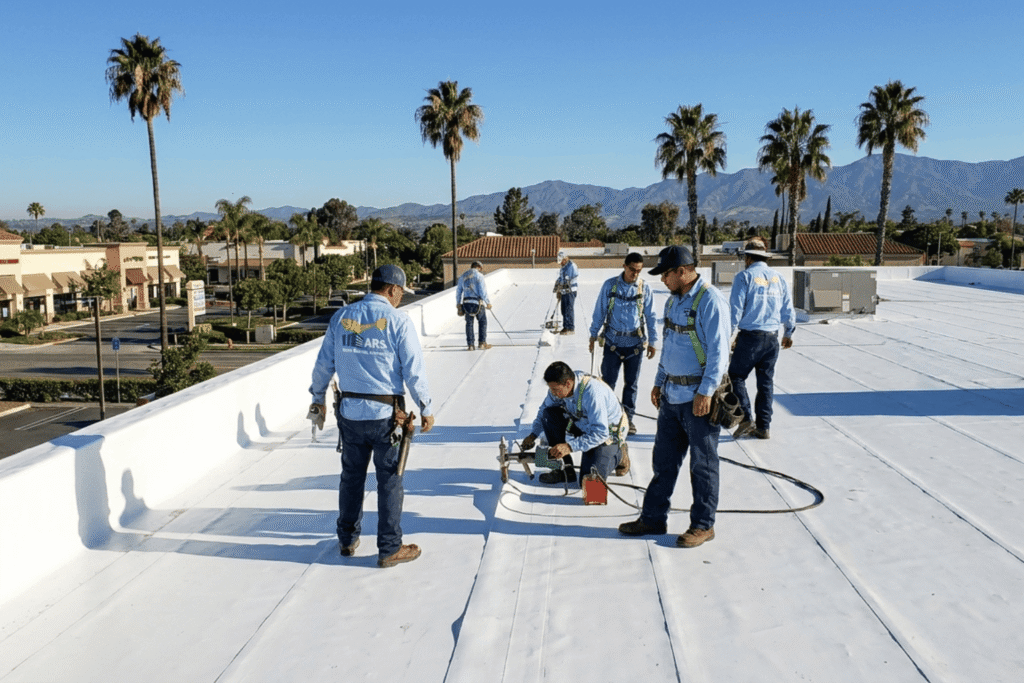
Commercial & Industrial Roofing in 2026: What’s Changed
The roofing world in 2026 has moved well past shingles and hot tar. The best industrial roofing contractors are keeping pace with where the market’s headed.
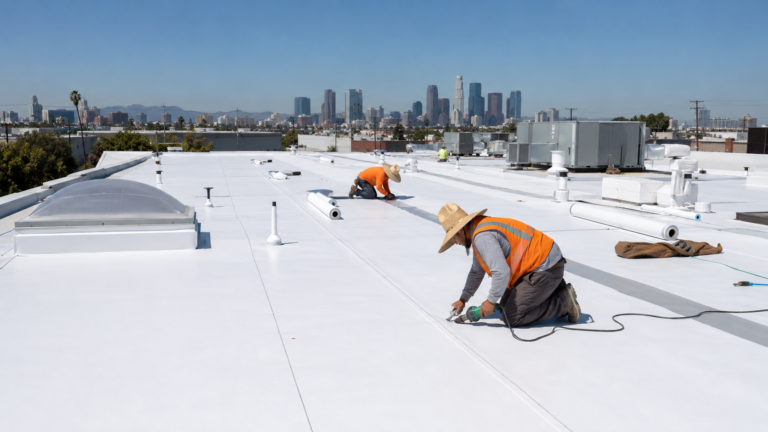
Cool roofs are now the default. California’s energy codes have made reflective “cool roofs” the standard specification, not the upgrade — and on an industrial building, a white membrane can cut roof surface temperatures dramatically, meaning lower cooling loads all summer.
Solar-ready roofing is the smart play. Commercial solar arrays last for decades. If your roof has only a few years left and you install solar on top of it, you’ll be tearing off that array to re-roof far too soon. Forward-thinking facility managers now spec a heavy-duty membrane as the base layer so the roof outlasts the panels — and a good industrial roofing contractor builds that lifecycle math in from the start.
Thermal imaging finds trouble before you cut. Before designing a retrofit, we can survey your existing roof and locate trapped-moisture pockets under old built-up or gravel systems without cutting into it. That tells us exactly what has to come out and what can stay — a more precise, more cost-effective project.
System Showdown: What Goes on Industrial Roofs
Let’s settle the material question honestly. Any industrial roofing contractor worth their salt should be able to walk you through this clearly, without steering you toward whatever carries the fattest margin.
System | Best For | Lifespan | Cool Roof / Title 24 | Standout Strength |
TPO | General industrial & warehouse | 20–30 years | ✅ Naturally compliant (white) | Best all-around value; welded seams |
PVC | Grease/chemical exposure, food processing | 20–30 years | ✅ Naturally compliant (white) | Chemical resistance; strongest seams |
Spray Foam (SPF) | Complex roofs, many penetrations | 20–30+ years (recoat) | ✅ Compliant (coated) | Seamless; self-flashes; adds insulation |
Modified Bitumen | High-traffic industrial roofs | 15–25 years | ⚠️ With reflective surfacing | Rugged, redundant waterproofing |
Silicone Coating | Restoring a sound existing roof | 10–20 years (renewable) | ✅ Compliant | No tear-off; ponding-water resistant |
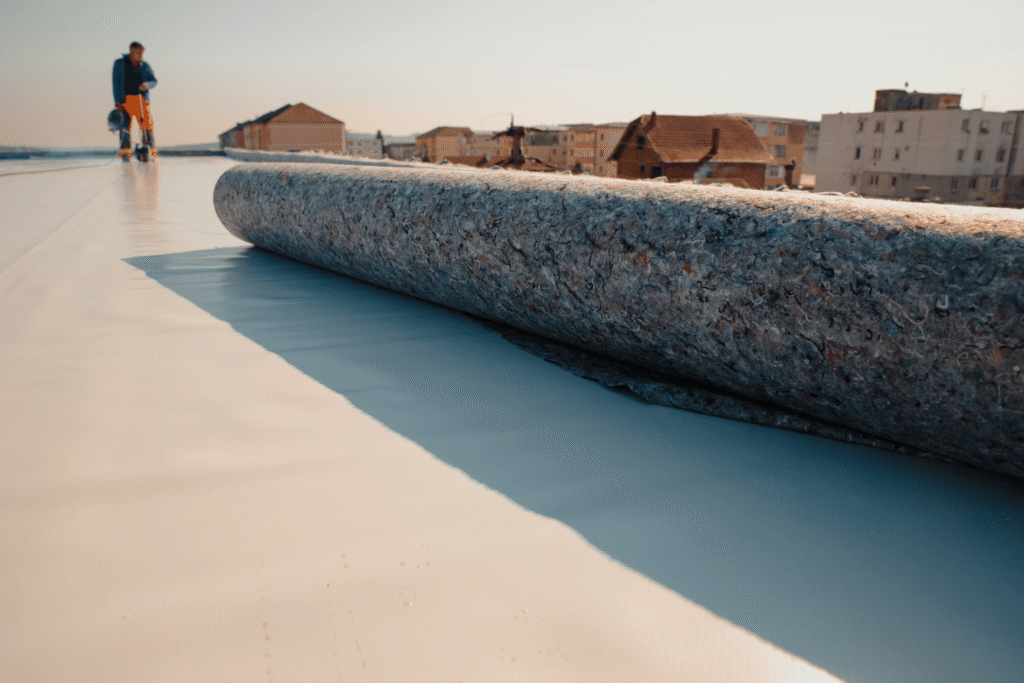
The honest read? For most industrial buildings in Orange, a white single-ply membrane — TPO for general use, PVC where grease or chemicals are in play — delivers the best balance of durability, energy performance, and value. Spray foam shines on complicated rooftops, and silicone coatings are the budget-smart move when an existing roof is worn but structurally sound. The right industrial roofing contractor recommends the system that fits your building, not the one that’s easiest to sell.
The 5 Things That Separate a Real Industrial Roofing Contractor From a General Roofer
When facility managers ask us what they should actually be looking for, this is the short list:
1
Seam-Welding Expertise That’s Actually Certified
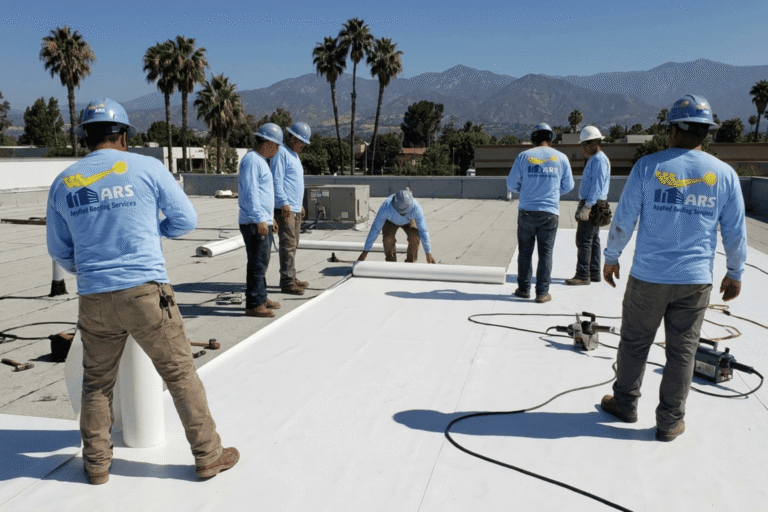
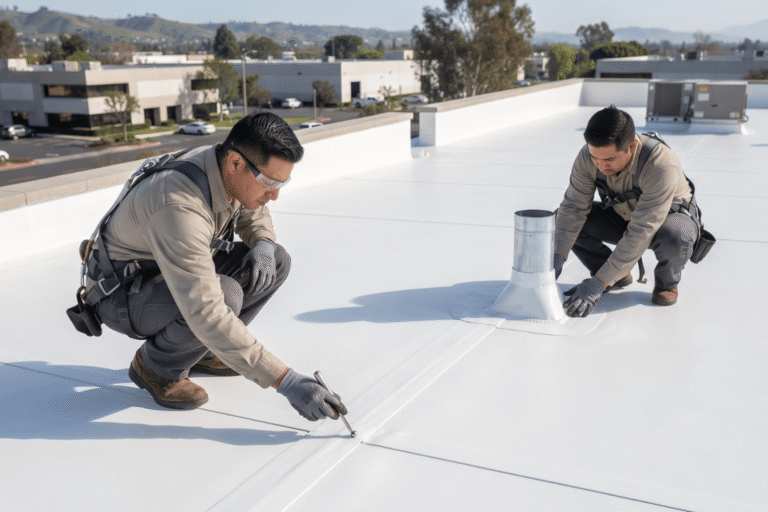
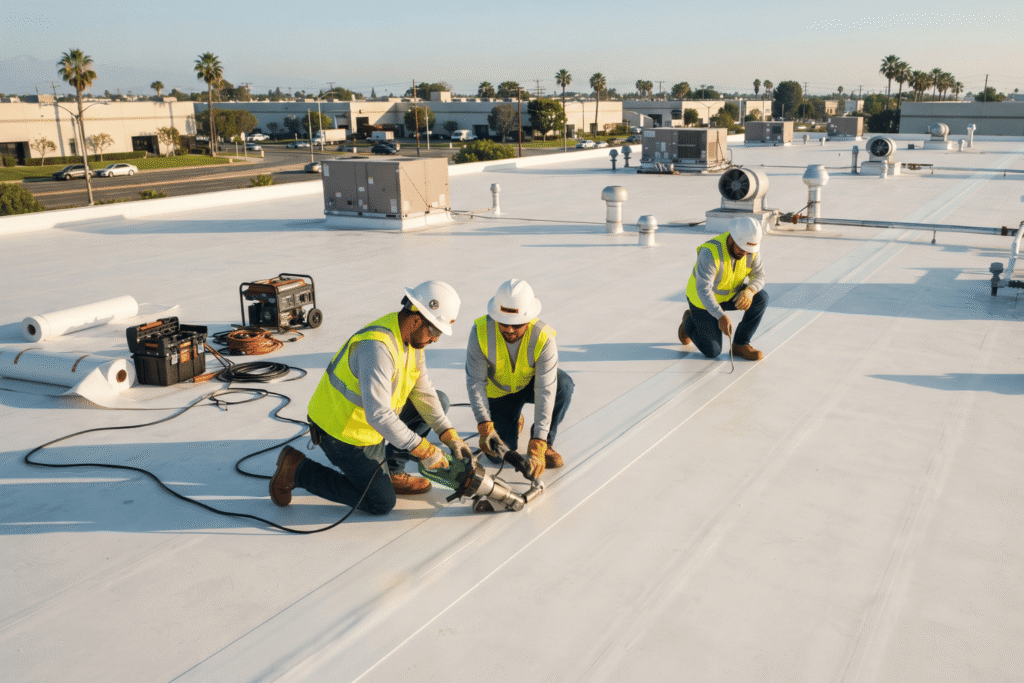
On single-ply industrial roofs, the seams are the roof. Hot-air-welded seams should form a molecular bond that’s stronger than the membrane itself — and every seam should be probe-tested. A specialized industrial roofing contractor has the equipment, the certified crews, and the quality-control discipline to guarantee that. A general roofer who dabbles in membrane work usually doesn’t.
2
Flashing and Penetration Detailing That Holds
The majority of industrial roof leaks start at penetrations and transitions, not in the open field. Meticulous flashing around every curb, pipe, and edge is where a great contractor earns their fee — and where a cheap one plants the seeds of failure.
3
The Ability to Work Around Live Operations
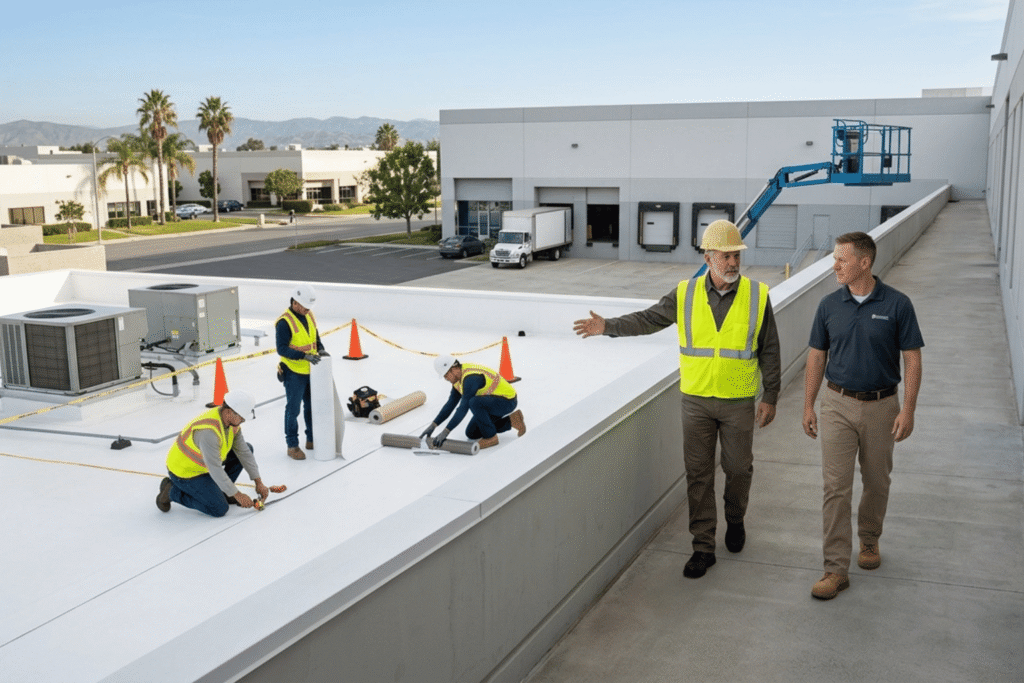
A true industrial roofing contractor can phase and sequence a project so your facility keeps running underneath. Safety planning, staging, and coordination on a working industrial site is a real skill, and it protects both your people and your production schedule.
4
Licensing, Insurance, and Manufacturer Certification
You want a fully licensed California contractor carrying full general liability and workers’ comp on every project — because on a busy industrial rooftop, that protects you from serious exposure. Manufacturer certification also unlocks the long-term warranties that off-brand installers simply can’t offer.
5
Straight Answers and No-Surprise Pricing
The best industrial roofing contractor gives you an itemized written estimate, explains the trade-offs between systems in plain language, and holds the quoted price short of scope changes you’ve agreed to in writing. Facility managers who’ve been burned by change-order-heavy contractors tell us this is what they value most.
Our Proven Process: Smart Retrofits Over Full Tear-Offs
Here’s where Applied Roofing Services stands apart — and where two decades of Southern California industrial experience pays off for our clients.
A lot of building owners assume a new industrial roof means ripping everything off down to the deck, hauling it away, and starting over. That process is expensive, disruptive to operations, and frequently unnecessary. As your industrial roofing contractor, we’ve refined the custom-fit retrofit. Here’s how it works:
Step 1: Thermal Imaging Assessment
Before we touch anything, we survey your existing roof with thermal imaging to map any moisture-laden sections of the current built-up, gravel, or aged membrane system that must be addressed before we overlay new material.
Step 2: Targeted Removal of Compromised Areas
We don’t tear off what’s still working. Wet or badly damaged sections are removed surgically, cutting your tear-off and landfill disposal costs — often a substantial saving on a large industrial roof compared to a full tear-off.
Step 3: Recovery Board Installation
A layer of high-density recovery board goes over the existing surface, creating a clean, smooth substrate for the new membrane, adding R-value to your building envelope, and providing a solid platform for proper attachment.
Step 4: Custom System Specification
No two industrial roofs are alike. We specify the exact membrane and mil thickness, the attachment method based on your wind zone and deck type, and custom detailing for every penetration, HVAC curb, and drain on your roof.
Step 5: Hot-Air-Welded Installation
This is where our certified crews earn their reputation. Every seam is hot-air welded into a molecular bond — not glued, not taped — and then probe-tested along its full length. On an industrial roof, that seam quality is the single biggest predictor of a leak-free future.
Step 6: Final Inspection & Warranty Documentation
Every project closes with a detailed seam-probe inspection, a full walkthrough, and complete manufacturer warranty documentation. Our clients get their peace of mind in writing.
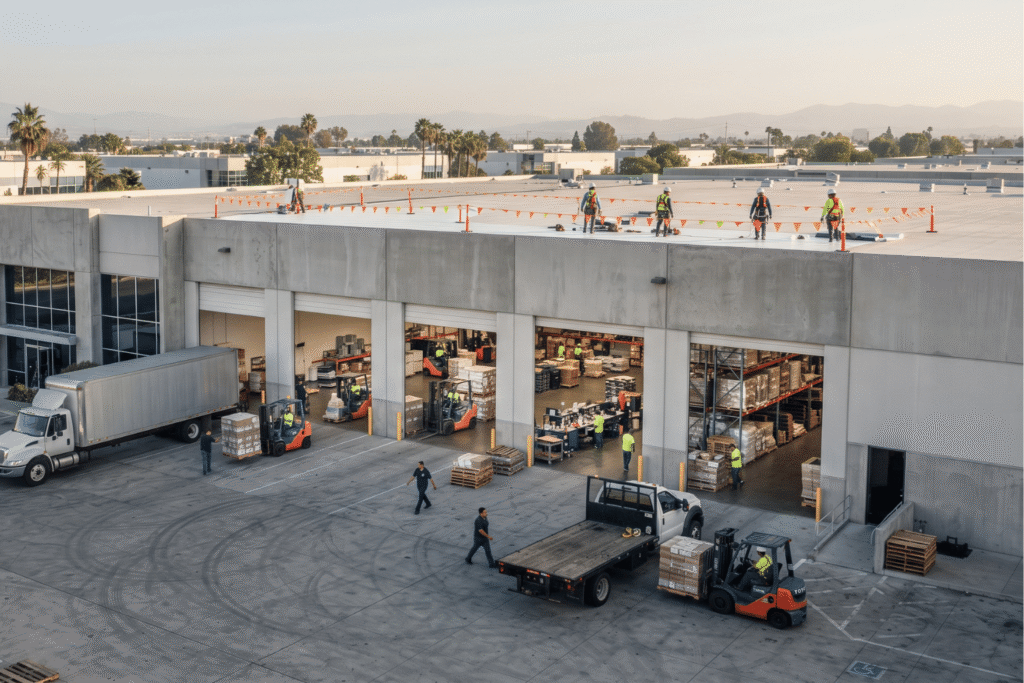
Ready to Talk to an Industrial Roofing Contractor Who Actually Gets It?
Look — there are plenty of roofing companies in Orange County. But few have been doing this since 2003, understand the specific thermal, wind, chemical, and regulatory demands of industrial buildings in the Orange market, and treat every roof as a custom engineering problem rather than a cookie-cutter install.
At Applied Roofing Services, we’ve built our reputation on being the industrial roofing contractor facility managers call back — not the one they regret calling the first time. Whether you run a distribution center off the 57, a manufacturing plant near the 22, or a processing facility anywhere in Orange County, we have the experience, equipment, and certified crews to deliver a roof that lasts and keeps your operation running.
Your facility is a major asset. Protect it like one.
👉 Get your custom industrial roofing assessment at appliedroofingservices.com
Get Your Free Roofing Estimate Today
Los Angeles: (213) 255-3677
Inland Empire: (909) 361-6119
Or submit your project details online.

Frequently Asked Questions for Your Industrial Roofing Contractor
What does an industrial roofing contractor do that a regular roofer doesn’t?
A specialized industrial roofing contractor handles the scale, complexity, and operational demands unique to industrial buildings — massive roof areas, dozens of penetrations, heavy rooftop equipment, phased installation around live production, and precision hot-air seam welding. General roofers who occasionally take on membrane work rarely have the equipment, certified crews, or quality-control discipline these projects require.
How much does an industrial roof cost per square foot in 2026?
In the Orange County market, industrial roofing generally runs from about $5.00 to $12.00 per square foot installed, depending on the system chosen, membrane thickness, building height and access, the number of rooftop penetrations, and the condition of the existing substrate. A silicone restoration of a sound existing roof can cost considerably less, while a full tear-off-and-replace sits at the higher end.
Can you install a new industrial roof without shutting down my operation?
Yes. An experienced industrial roofing contractor phases and sequences the project so your facility keeps running underneath. We stage the work, manage safety on a live site, and coordinate around your production schedule to minimize any disruption to operations.
Do I have to tear off my old roof completely?
Often, no. If your existing roof has no more than one layer, a structurally sound substrate, and dry insulation, we can frequently install a recovery board and new membrane over it — or restore it with a silicone coating — which saves significant tear-off and disposal cost. We use thermal imaging to confirm the roof is a good candidate before recommending a retrofit.
Which roofing system is best for an industrial building in Orange?
For most industrial buildings, a white single-ply membrane is the strongest choice: TPO for general applications and PVC where grease, oils, or chemicals are present, such as food processing. Spray foam suits complex rooftops with many penetrations, and silicone coatings are ideal for restoring a worn but sound roof. The best system depends on your building, which is why we assess every roof before recommending one.
Does a reflective industrial roof really lower energy costs?
Yes. A white, reflective membrane can cut roof surface temperatures dramatically compared to a dark roof, reducing the heat transferred into the building and lowering cooling costs during Orange’s hot summers — while also satisfying California’s Title 24 cool-roof requirements.
How do I know the seams on my industrial roof were welded correctly?
Proper seam welds are verified by probing — running a tool along the seam to confirm continuous fusion across the full weld. A good industrial roofing contractor probe-tests every seam as standard practice. When vetting any contractor, ask directly about their seam quality-control procedures; the answer tells you a lot.
Why should I hire a licensed and insured industrial roofing contractor?
On a busy industrial rooftop, a fully licensed contractor carrying general liability and workers’ compensation insurance protects you from serious financial exposure if an incident occurs on site. Licensing and manufacturer certification also unlock the long-term, manufacturer-backed warranties that off-brand installers can’t provide.