Short answer: To prepare a commercial roof in Los Angeles for El Niño, do five things before the first big storm:
- Clear and water-test every drain, scupper and downspout.
- Re-seal flashings, HVAC curbs and penetrations.
- Find and fix ponding areas.
- Repair or coat UV-aged membranes.
- Get a dated, photo-documented inspection report for your insurer and warranty file.
Applied Roofing Services does all five on low-slope commercial roofs across LA County. Inspections are free and quotes go out within 48 hours.
The phone calls start the same way every El Niño year. A property manager in Commerce tells us the warehouse roof “never leaked before.” A facilities director in Van Nuys has water coming through a light fixture over the production floor.
We’ve been roofing commercial buildings in Southern California since 2003. In our experience, most El Niño leaks were already there in October. Dry weather just kept them hidden.
This page explains how we prepare commercial roofs in Los Angeles for the 2026-27 El Niño. It covers what we check, what we fix, and which repairs can still be done once the rain starts. It also covers what your team can do this week without setting foot on the roof.
Ready for a Free Flat Roofing Estimate?
Call our office: (714) 632-8418
Where the 2026-27 El Niño stands right now
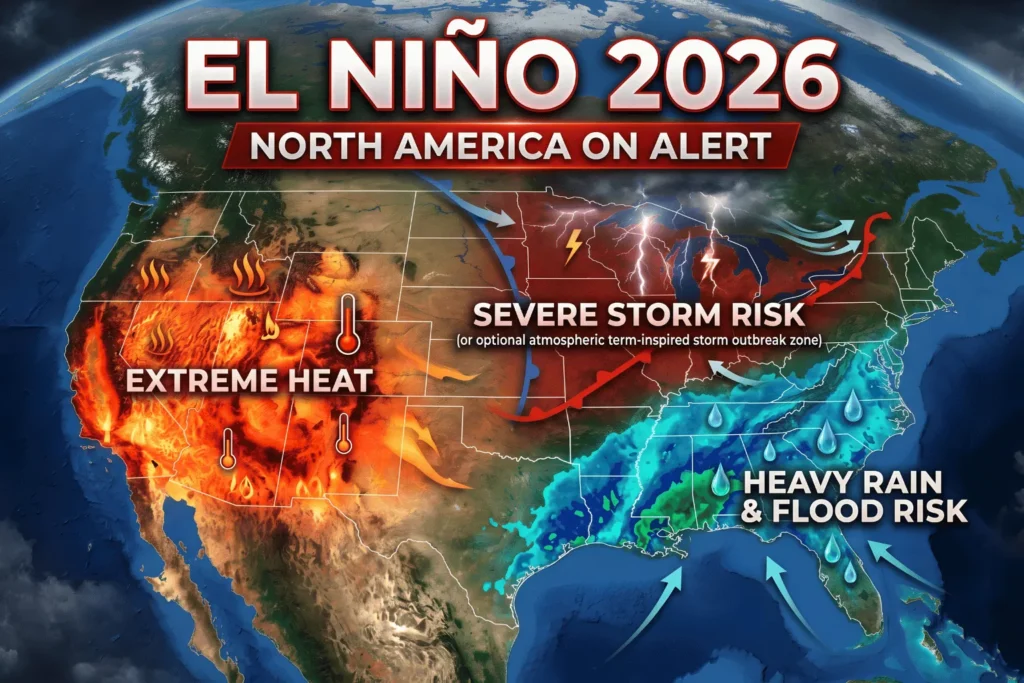
This is not a “maybe” year. NOAA’s Climate Prediction Center first issued its El Niño Advisory in June, and the event has grown stronger every month since.
- The October 8 update says El Niño continues to strengthen, with a strong-to-very strong event likely through January-March 2027 (greater than an 83% chance). noaa
- Record territory: NOAA puts the odds that October-December 2026 exceeds every El Niño on record since 1950 at 83%. noaa
- Duration: forecasters expect El Niño to persist through March-May 2027, so the storm risk lasts well into spring. noaa
- Next update: NOAA’s next ENSO Diagnostic Discussion is scheduled for November 12, 2026. noaa
Los Angeles County is treating it as a serious threat. Board Chair Hilda Solis issued a local emergency proclamation ahead of the 2026-27 storm season, and the County marked the official start of storm season on October 1, 2026. Govdeliverygovdelivery
What a very strong El Niño has meant for LA roofs before
A strong El Niño raises the odds of a wet winter. It does not guarantee one. During the 2015 event, California’s state climatologist noted that only about half of past big El Niños brought meaningful heavy rain. That winter ended up drier than forecast across most of Los Angeles. insurancejournal
The 1997-98 event is the reason building owners take these forecasts seriously:
Station | 1997-98 rainfall | Normal (1991-2020) |
Downtown LA (USC) | 31.01 inches | 14.25 inches |
LAX | 31.28 inches | 12.23 inches |
Burbank | 37.18 inches |
That is more than double the normal total, and it fell on roofs that had baked through a dry summer.
Our position is simple. Treat the forecast as a deadline, then do the work that pays off even if the rain underdelivers. Clean drains, sealed flashings and a documented roof condition are worth having every winter.
Why flat commercial roofs in Los Angeles fail during El Niño storms
Most commercial buildings in LA County have low-slope roofs: warehouses, distribution centers, strip retail, office parks and manufacturing plants. These roofs only shed water when the drainage path works and the membrane is intact. Here is where they fail.
1. Clogged drains, scuppers and downspouts
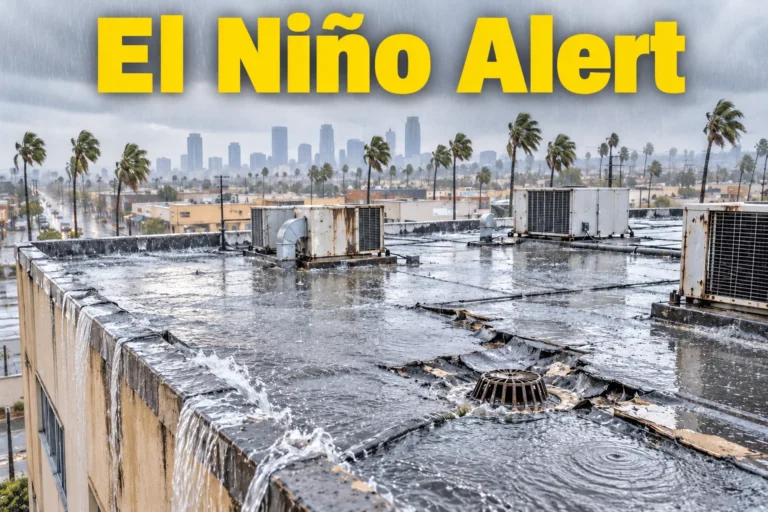
This is the number one cause of El Niño leak calls we answer. Dust, leaves, palm fronds, pigeon nests and old construction debris build up over the dry months. In burn-scar areas, ash and windblown debris add to it.
Under normal winter rain, a drain that is half blocked can still keep up. In an atmospheric river, it can’t. Water then backs up against parapet walls, over curb flashings and into any seam with a weak spot.
2. Ponding water and the load it adds
Roofers define ponding as water that is still standing 48 hours after rain stops. Every inch of water on a roof adds about 5.2 pounds per square foot. For comparison, many older low-slope roofs in LA were designed for a roof live load of around 20 psf.
On a 50,000 sq ft warehouse, one inch of rain is roughly 31,000 gallons of water. All of it has to reach a drain.
Persistent ponding causes three problems:
- It speeds up membrane breakdown.
- It can void manufacturer warranties.
- On deck areas that already sag, it causes more deflection, which collects more water.
3. Flashings, curbs and penetrations
The middle of the roof rarely fails first. Leaks usually start at the edges and openings:
- HVAC curbs
- Skylights and smoke hatches
- Pipe boots and conduit penetrations
- Parapet copings
- Expansion joints
- Places where a solar racking or telecom installer cut through the membrane and never sealed it properly
Every piece of rooftop equipment added since your last re-roof is a possible leak point.
4. UV-aged membranes and coatings
Los Angeles sun is hard on roofing. Over the years:
- TPO top plies wear thin and develop surface crazing.
- Modified bitumen loses its granules.
- Built-up roofs (BUR) blister and “alligator.”
- Acrylic coatings chalk off.
None of this looks dramatic from a ladder. Under sustained rain, though, worn areas soak through.
5. Santa Ana wind damage that nobody saw
Santa Ana winds in October and November lift membrane edges, loosen metal flashing and scatter debris across the roof. The damage stays hidden until the first storm finds it.
6. Wind-driven rain
El Niño storms often arrive with strong southerly winds. Rain gets pushed sideways into rooftop units, louvers, wall-to-roof transitions and parapet caps. Some of these “roof leaks” are really building envelope leaks. A proper inspection tells you which is which, so you pay for the right repair.
Our El Niño commercial roof preparation service
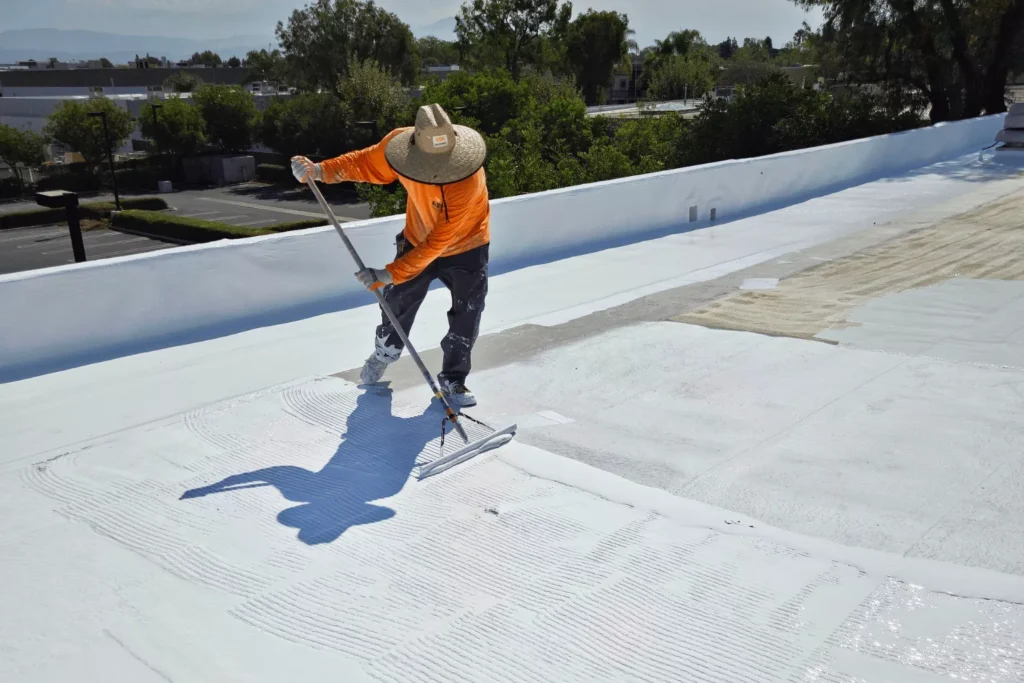
This is what an Applied Roofing Services pre-storm visit includes. The inspection and written report are free for commercial buildings in our service area.
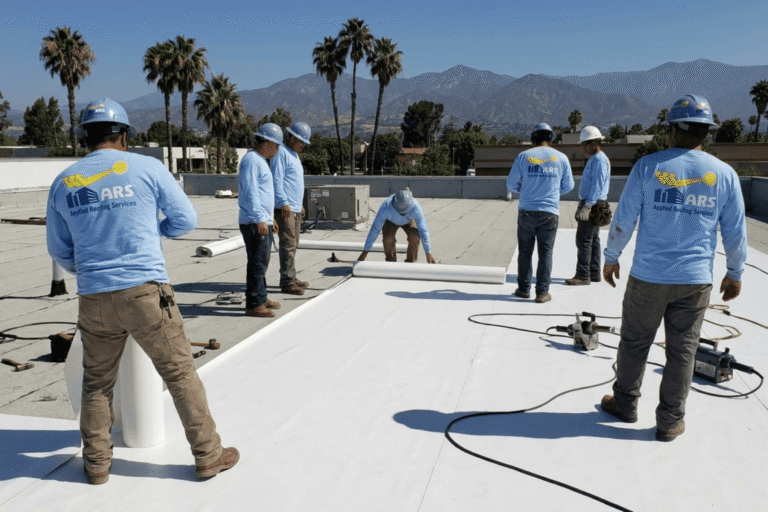
- Full roof walk and condition survey. A foreman with 20+ years of field experience walks the whole roof. That includes the field, perimeter, every penetration, equipment curbs and roof-to-wall transitions. Our crews are OSHA fall-protection certified on every job.
- Drain, scupper and overflow testing. We clear debris, then run water through the drains to confirm they flow. We look for crushed leaders, missing strainers and overflow scuppers set at the wrong height.
- Ponding map. We mark low areas and note how deep they get and how big they are. These areas get tapered insulation, crickets, added drains or a ponding-tolerant coating.
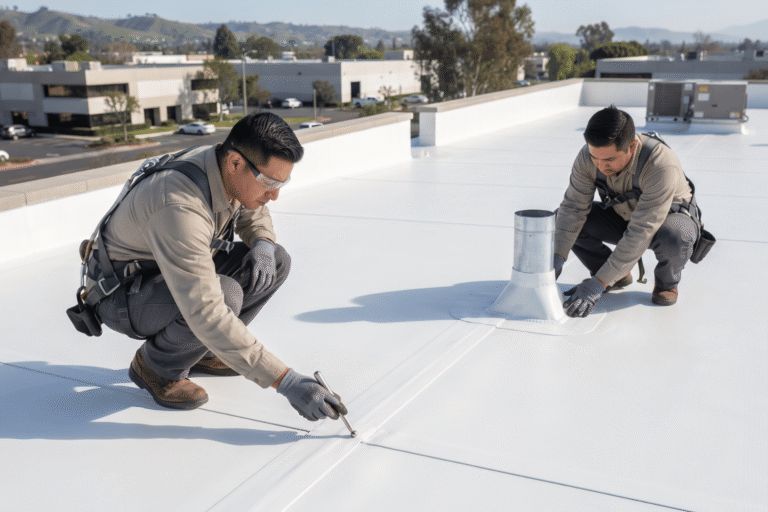
- Seam and flashing checks. On single-ply roofs we probe the seams. On SPF and coated roofs we check coating thickness and look for exposed foam. Base and counter flashings get checked everywhere.
- Moisture assessment on suspect areas. Wet insulation under the membrane is the reason “the roof looks fine” and “the ceiling tiles are stained” can both be true. We find it before deciding between repair, restoration and replacement.
- Dated photo report. You get labeled photos, a roof plan with marked problem areas, and repairs ranked by urgency. Keep it in your insurance file and warranty records.
- Repair now, plan the rest. We fix urgent items before the storm window. Larger work is scheduled around dry-weather forecasts, with temporary protection in between.
- Storm-season follow-up. Maintenance clients get post-storm drain checks and priority scheduling when a leak shows up.
This work falls under our roof repair and maintenance service. For a full year-round program, see our guide to preventive roof maintenance.
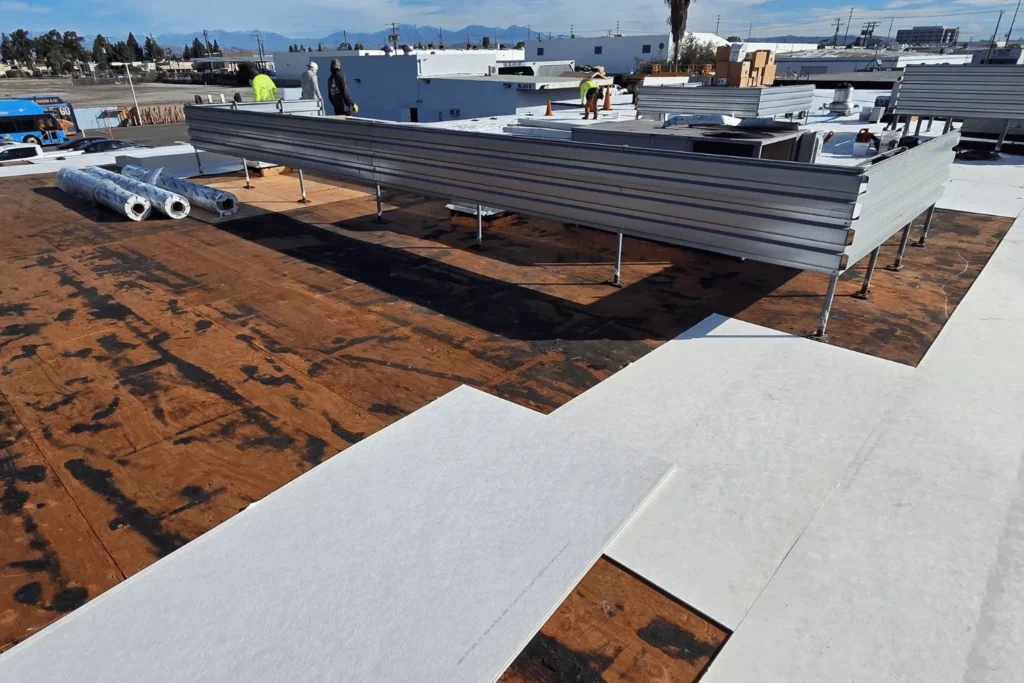
How each commercial roof system holds up to El Niño rain
Different roof systems fail in different ways. Here is what we check on each one and what can still be done once the rainy season starts.
Roof system | Where it fails in heavy rain | What we check before El Niño | Typical pre-storm fix | Can work continue during rainy season? |
Spray polyurethane foam (SPF) | Worn coating that exposes foam to UV and water; mechanical damage around equipment | Coating thickness, exposed or eroded foam, blisters, foot-traffic wear | Spot repairs with compatible sealant; full recoat where coating is thin | Spot repairs yes. New foam needs a dry roof surface, so full SPF jobs are scheduled between storms |
Silicone coating | Rarely in the field; usually at old seams or flashings left uncoated | Adhesion, thickness, dirt buildup, uncoated details | Clean and add silicone at details and wear areas | Yes. Silicone tolerates ponding and many products resist rain within hours of application |
Acrylic / elastomeric coating | Ponding areas where acrylic softens and comes loose | Chalking, ponding spots, delamination | Fix drainage first; switch to silicone in ponding zones | Limited. Acrylic needs warm, dry curing time |
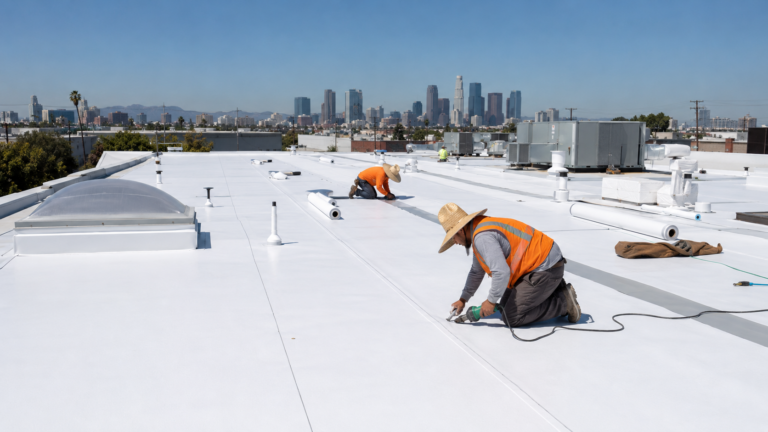
TPO single-ply | Seam separation, worn top ply, punctures, flashing pull-away | Probe seams, check perimeter and curb flashings | Heat-weld repairs, patches, flashing rework | Yes, between storms on a dry surface |
PVC single-ply | Shrinkage at perimeters, brittleness on older sheets | Perimeter tension, corner flashings, seam welds | Welded repairs; replace brittle flashing | Yes, between storms |
Built-up roof (BUR) / gravel | Blisters, splits, hidden wet insulation, clogged drains from loose gravel | Blisters, splits, gravel stops, drain strainers | Cut and patch blisters; clear gravel from drains; consider a restoration coating | Patching yes; restoration in dry windows |
Modified bitumen | Lap edges, granule loss, cracked flashings | Lap seams, granule loss, flashing cracks | Re-seal laps; mastic and fabric at flashings | Yes for repairs |
Metal (warehouse) | Loose or backed-out fasteners, rusted seams, gutter overflow | Fasteners, end laps, gutter capacity | Re-fasten, seal laps, or coat the whole roof | Repairs yes; coating in dry windows |
For a deeper look at system choice, read The Ultimate Guide to Commercial Roof Installation: Foam, Single Ply, or Coatings? and Built-Up Roof vs. Modified Bitumen.
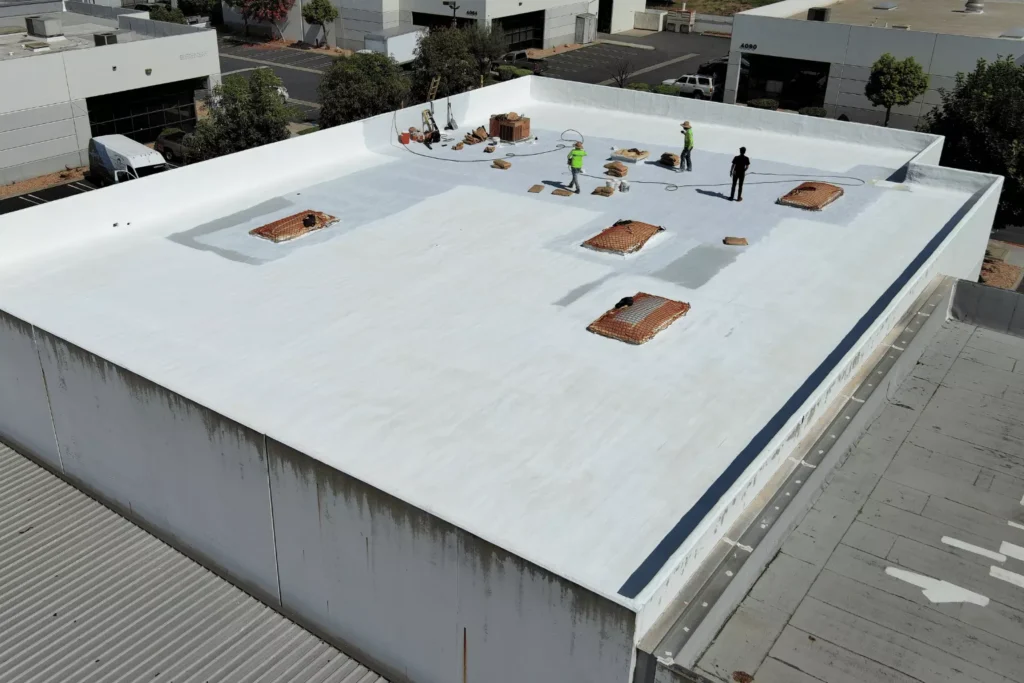
Repair, restore or replace before the rain?
Owners often ask whether they should rush a full replacement before El Niño. Usually, no.
A full tear-off on a large warehouse can leave the roof partly open for days or weeks. In a season with back-to-back storms, an open roof is a bigger risk than an old one. We usually recommend this order instead: repair now, restore where the roof is still sound, and schedule replacement for the dry season. The exception is a roof so soaked or deteriorated that patching would waste money.
Silicone restoration: the most common El Niño-season fix
A silicone roof coating goes over a roof that is aged but still solid. It works over SPF, TPO, BUR, modified bitumen and metal. It has three advantages in an El Niño year:
- It handles ponding water better than acrylics.
- It cures fast enough to fit between storms.
- It adds reflectivity for Title 24 and summer cooling.
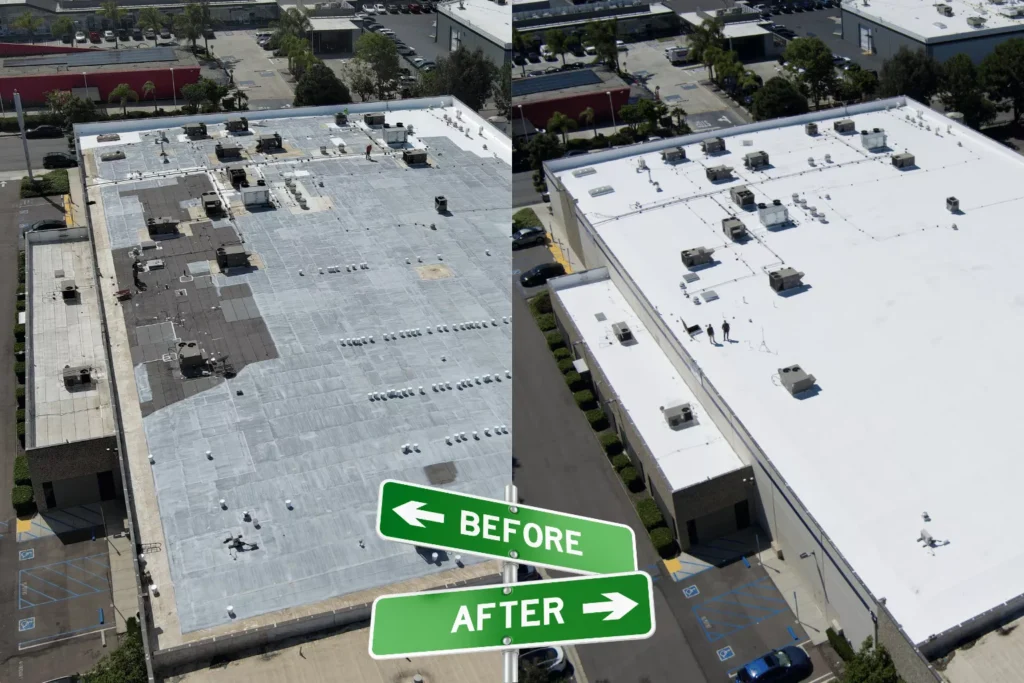
Coating restoration typically adds 10 to 15 years of service life for a fraction of replacement cost. One of our facilities clients, Linda Chao of Pacific Logistics, chose a silicone restoration on her Anaheim warehouse. In her words: “ARS came in competitively and finished a week ahead of schedule. No leaks two years later.” Learn more in The Power of Silicone Roof Coatings and Silicone Roof Coating: What You Need to Know.
Spray polyurethane foam: our specialty since 2003
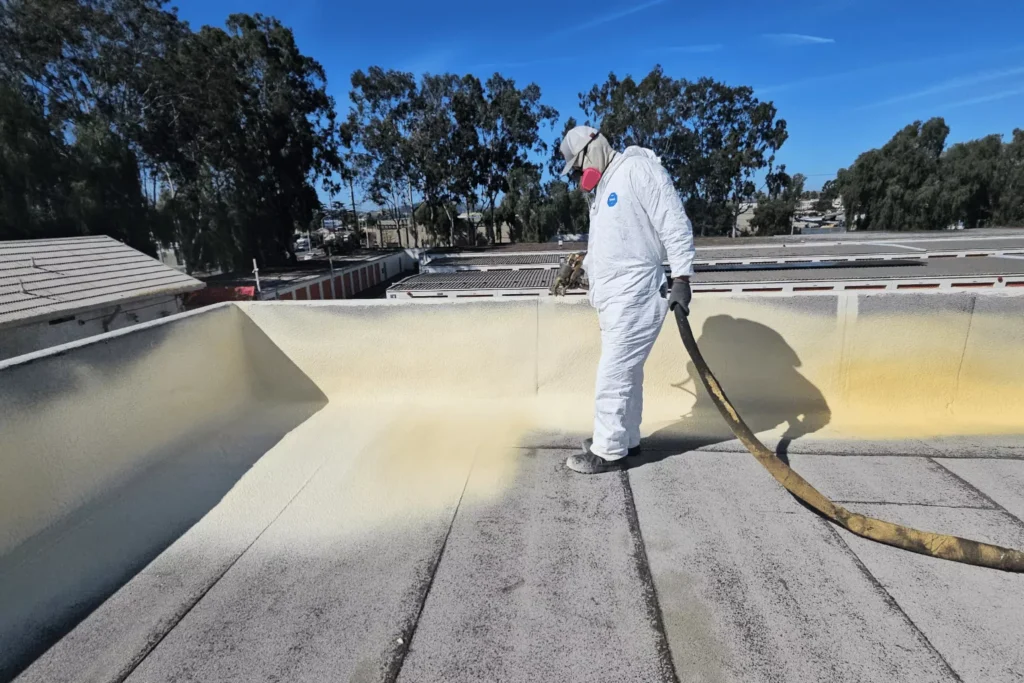
Spray polyurethane foam is a fully adhered roof with no seams. It flashes itself around penetrations, which is where most El Niño leaks start. It also delivers the highest R-value per inch of any commercial roofing system.
We can build up foam to correct low spots that pond. The trade-off is weather: foam must go onto a clean, dry surface. New SPF installations this winter will be planned around dry forecast windows. Repairs to existing foam roofs can be done most of the season.
Related reading: How Long Does Spray Foam Roofing Last?, Spray Foam Roofs and Dry Time and 7 Spray Foam Roofing Myths Debunked.
TPO and PVC single-ply
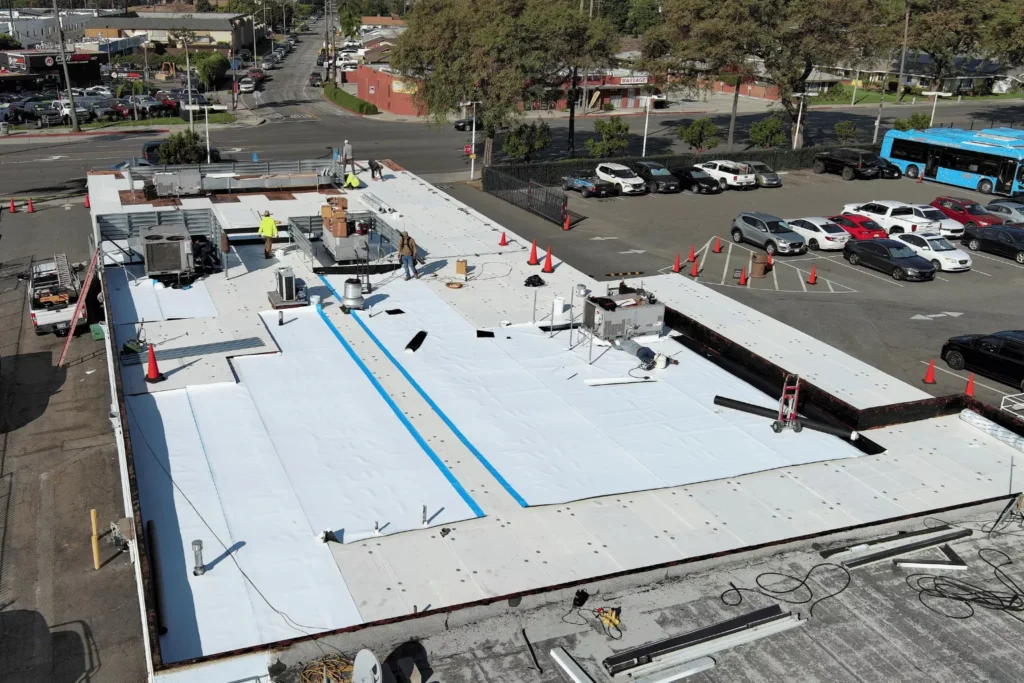
TPO and PVC membranes are repaired by heat-welding, which works on any dry day. Before El Niño, we focus on three things: seams, perimeter edges and curb flashings. See Expert TPO Roof Installation and our PVC roofing contractor page.
When replacement is the honest answer
Some roofs are past saving: wet insulation across large areas, rotten decking, or several past failed restorations. For those, we provide temporary protection now and a commercial roof replacement plan for spring. Before you decide, read Benefits of Commercial Re-roofing and Things to Consider Before Removing an Old Roof.
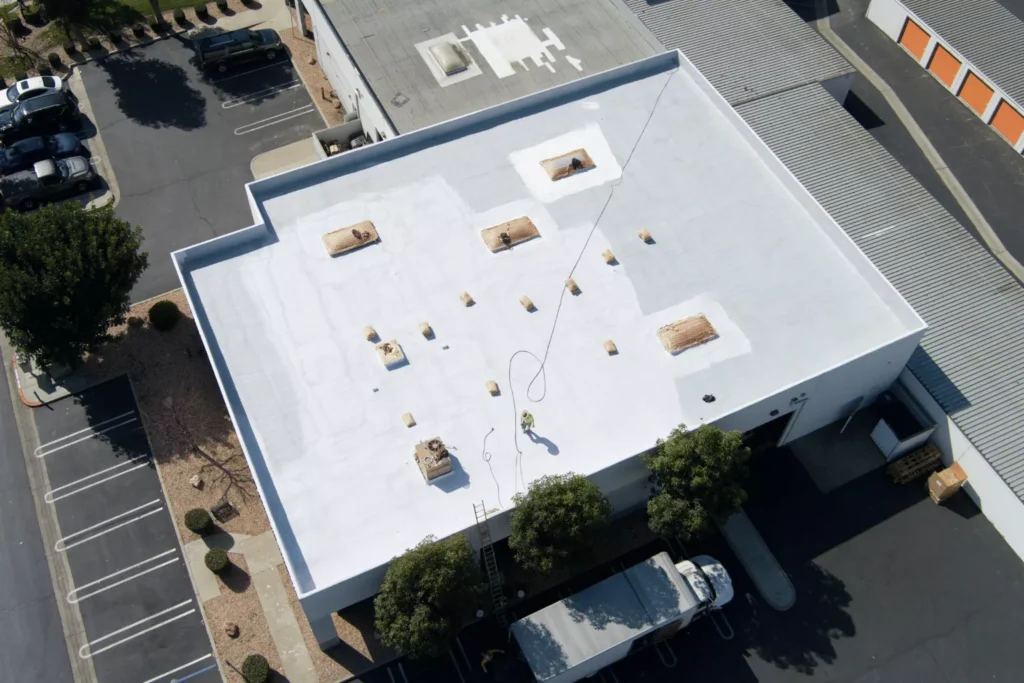
Your El Niño roof timeline: late October 2026 through spring 2027
Many competitor guides say the deadline was September. We disagree. Late October and November is still a workable window for inspection, drain work and most repairs. It is closing fast, though.
In 2015, a Culver City company reported a four-fold increase in calls and a two-week wait for evaluations once El Niño headlines took off. Expect similar backlogs this year. insurancejournal
This week
- Book a pre-storm inspection.
- Pull your roof warranty, the last inspection report and records of any past leaks.
- Have your team do the ground-level checks listed below.
Next two to three weeks (before Thanksgiving)
- Clear and water-test drains.
- Complete urgent flashing and seam repairs.
- Coat ponding areas that can’t be re-sloped before winter.
- File the dated photo report with your insurance records.
December through March (peak storm season)
- After each major storm, check drains and look inside for new stains.
- Call for leaks right away. Fast response limits interior damage and shows your insurer you acted quickly.
- Schedule dry-window work as forecasts allow.
April through June 2027
- Do a post-season inspection.
- Schedule replacement or restoration work during the dry season.
- Budget for the next fiscal year.
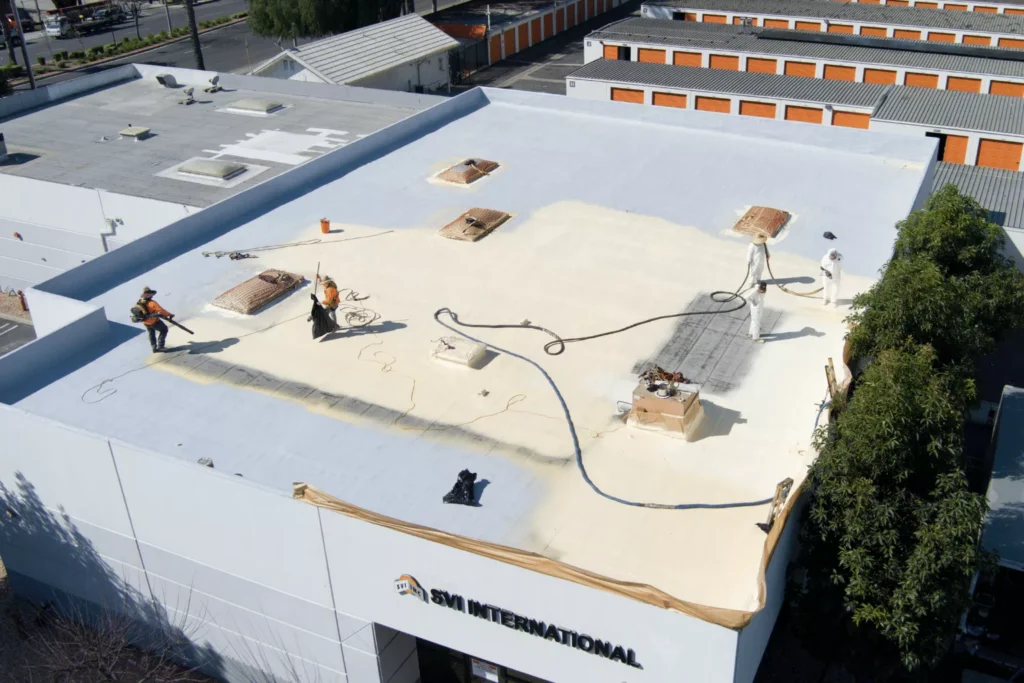
El Niño roof preparation across Los Angeles neighborhoods
Rain doesn’t fall evenly across LA County, and buildings differ by area. In 1997-98, Burbank logged six more inches than LAX. Here is how our prep work changes by area. Our crews drive out of our Orange headquarters every day to job sites across all of these communities.
Industrial core: Vernon, Commerce, City of Industry, Santa Fe Springs, Downtown LA Arts District, Boyle Heights
Large distribution and manufacturing roofs, often with decades of add-on equipment. Expect long drain runs, rooftop HVAC everywhere, and older BUR or modified bitumen under coatings. The main risks are drain capacity and penetration counts. Read our guide on industrial roofing contractors.
South Bay and the harbor: Torrance, Carson, Gardena, El Segundo, Hawthorne, Wilmington, San Pedro, Long Beach
Salt air corrodes metal flashings, fasteners and rooftop unit housings. Strong southerly winds push rain under coping caps. We pay extra attention to metal components and parapet details.
Westside and coastal: Santa Monica, Marina del Rey, Culver City, Playa Vista, West LA
Mixed-use buildings with roof decks, pavers and amenity spaces hide leaks under layers of finish materials. Wind-driven rain and wall-to-roof transitions cause most of the problems here.
San Fernando Valley: Van Nuys, Sun Valley, North Hollywood, Burbank, Glendale, Chatsworth, Sylmar, Pacoima
Hot summers age membranes and coatings faster than near the coast. Many tilt-up warehouses and older flat-roof commercial buildings sit near the foothills, where storms can stall and dump heavy rain.
San Gabriel Valley: Pasadena, Altadena, Arcadia, Monrovia, Azusa, Irwindale, El Monte, Pomona, West Covina
Properties near the 2025 Eaton Fire burn area face extra ash and debris on roofs and in drains, plus higher mud and debris-flow risk at ground level. LA County warns that burn scar areas are at higher risk for certain hazards this season. Clear drains more often here. govdelivery
Santa Clarita Valley: Valencia, Saugus, Newhall
Newer business parks, often with single-ply roofs. Check that rooftop solar and equipment installed after the original roof was properly flashed.
Palisades and Malibu corridor
Commercial properties near the 2025 Palisades Fire area should have drains and roof surfaces checked for debris and heat damage before the first storm.
We also serve the rest of Southern California: Orange, Riverside, San Bernardino and San Diego counties.
Warranty Matters: Applied Roofing Services installs flat roofing systems from industry-leading manufacturers and can provide manufacturer-backed warranties of up to 20 years on qualifying installations. A contractor offering a dramatically lower price is almost certainly using thinner membrane, off-brand products with no manufacturer warranty support, or cutting corners on seam and flashing quality. Always ask what warranty comes with the system — not just the material.
Paperwork that protects you: insurance, warranties, leases and permits
Insurance documentation
After a storm loss, adjusters want to know what the roof looked like before the storm and how fast you responded. One LA insurance agent notes that carriers first look at when the damage started and how quickly the owner acted. Our dated photo report gives you that record. We aren’t attorneys or insurance advisors. Check coverage questions with your broker. biggerpockets
Manufacturer warranty conditions
Most commercial roof warranties require regular maintenance and compatible repair materials. We are approved applicators for Carlisle, GAF, Henry and General Coatings. Our repairs on those systems use products that keep your warranty valid.
Lease responsibilities
Under triple-net (NNN) leases, roof maintenance often falls on the tenant. Under gross leases, it usually stays with the landlord. Either way, someone needs to own the roof before the rain. We write reports that both sides can use.
Permits and Title 24
Roof repairs generally don’t need a permit. A re-roof or larger replacement in the City of Los Angeles needs a permit from the Los Angeles Department of Building and Safety.
California’s Title 24 energy code sets cool-roof minimums for nonresidential low-slope roofs. The standard is aged solar reflectance of 0.63, thermal emittance of 0.75 and an SRI of 75, with exceptions for roof repairs and replacements covering 50% or less of the total roof area. Qualifying products are rated by the Cool Roof Rating Council. Every system we install meets Title 24 and Energy Star requirements. More on that in our energy-efficient roofing guide. caanetcaanet
Contractor verification
Demand spikes every El Niño year, and unlicensed operators show up with it. Verify any roofer on the CSLB license lookup. Ours is C-39 #821326. Ask for a certificate of insurance before anyone goes on your roof.
What your facilities team can do this week, without going on the roof
Leave roof access to trained crews with fall protection. From the ground and inside the building, your team can:
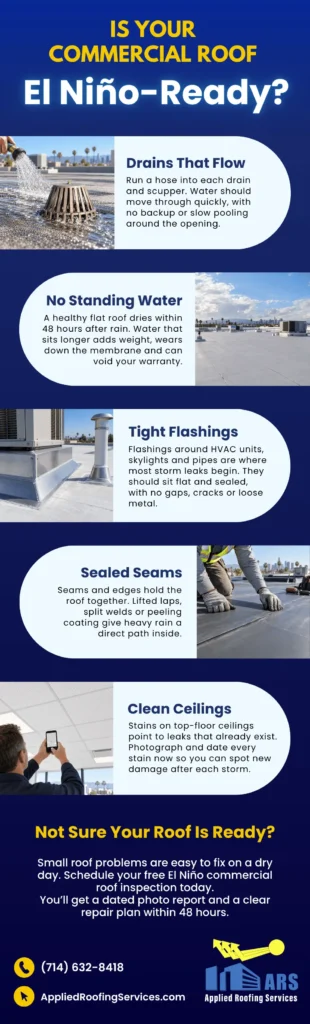
- Walk the building perimeter after an irrigation cycle or hose test. Look for downspouts that drip instead of flow, overflowing gutters, or water stains streaking down walls below scuppers.
- Check that downspouts discharge away from the foundation and into working site drains.
- Look up at ceilings, especially near HVAC units, skylights and exterior walls. Photograph and date any stains, so you can tell new damage from old.
- Check the top floor and mezzanines for rust on deck pans or stained insulation.
- Trim tree limbs that overhang the roof.
- Set up a tenant leak-reporting process: photo, exact location and one phone number to call.
- Move inventory, files and electronics away from known drip points.
- Keep sandbags on hand for low entries and loading docks. The Los Angeles Fire Department provides free sandbags at neighborhood fire stations. govdelivery
- For drainage questions about your property, LA County Public Works has engineers available at 800-933-0930. govdelivery
BOMA Greater Los Angeles gives commercial buildings similar advice. It recommends that property teams confirm engineering, security, property management and vendors know who handles storm preparation and response. Bomaonthefrontline
When a leak shows up mid-storm
- Get people and equipment away from the area. Shut off power to wet electrical fixtures.
- Catch the water and protect inventory. Take photos with timestamps.
- Call us at 714-632-8418. Maintenance clients get priority scheduling during storm season.
- Do not send staff onto a wet roof. Wet membranes and skylights cause serious falls.
- We stop the water with a temporary fix, then make the permanent repair once the roof is dry.
Read more in our emergency commercial roof repair guide and How to Be Prepared for Commercial Roofing Issues This Winter.
Why Los Angeles building owners call Applied Roofing Services
- Commercial roofing since 2003. More than 20 years on Southern California low-slope roofs.
- 10,000,000+ square feet installed and 1,700+ projects completed across warehouses, offices, retail centers and manufacturing plants.
- CSLB C-39 Roofing Contractor, License #821326. Licensed and insured.
- Approved applicator for Carlisle, GAF, Henry and General Coatings.
- Industry affiliations: Cool Roof Rating Council (CRRC), Spray Polyurethane Foam Alliance (SPFA), Energy Star and BBB.
- Foremen with 20+ years of field experience. OSHA fall-protection certified crews on every job.
- 5 to 20-year warranties available, depending on system.
- Free inspections and quotes typically within 48 hours.
A note from our founder: I started Applied Roofing Services in 2003 to build commercial roofs that hold up and to stand behind them afterward. Many of our clients have been with us for over ten years. They stayed because the roofs don’t leak and we answer the phone when it rains. Before this El Niño, I’d rather find your problem on a dry Tuesday in November than in a downpour in January. — Jeff Cardenas
Watch our crews at work on our videos page, or learn more about us.
Schedule your El Niño commercial roof inspection
Free for commercial properties in Los Angeles, Orange, Riverside, San Bernardino and San Diego counties.
Call 714-632-8418 or request your free roofing estimate.
Get Your Free Roofing Estimate Today
Contact Us Directly: (714) 632-8418
Or submit your project details online.
Applied Roofing Services, Inc. · 1961 N. Main St., Orange, CA 92865 · C-39 #821326
El Niño commercial roof preparation: Frequently Asked Questions
When should I prepare my commercial roof for El Niño in Los Angeles?
Now. LA County’s storm season officially began October 1, and NOAA expects the strongest El Niño conditions from late 2026 through March 2027. Late October and November is the last dependable window for inspection, drain clearing and repairs before peak storms. Roofers’ schedules fill quickly once heavy rain hits.
Is the 2026-27 El Niño going to be another “Godzilla” that never shows up?
No one can promise rain totals. The 2015-16 event underdelivered in Los Angeles, while 1997-98 more than doubled normal rainfall. This year’s event is forecast to be stronger than 2015-16. Prep work like clearing drains and sealing flashings pays off in any winter, so it isn’t wasted either way.
How much does a commercial roof inspection cost in Los Angeles?
Applied Roofing Services inspects commercial roofs for free in our service area. That includes a dated photo report. Repair quotes typically go out within 48 hours. Some firms charge for infrared or core-sample moisture surveys on large roofs. We’ll tell you up front whether your roof needs one.
Should I replace my roof before El Niño or wait?
Usually wait, and repair or restore now. A full tear-off during storm season can leave your building partly open. Most aging roofs can be made storm-ready with repairs or a silicone restoration, with replacement scheduled for the dry spring and summer months.
Can roofers work in the rain?
Not on the roof surface itself. Membranes, foam and most coatings need a dry surface to bond. During storms we make emergency temporary repairs to stop water. Permanent repairs happen during dry windows, and in LA these usually open within a day or two after a storm passes.
What is ponding water and why does it matter?
Ponding is water still standing on a roof 48 hours after rain. Each inch adds about 5.2 pounds per square foot, speeds up membrane wear, and can void warranties. We fix ponding with added drains, tapered insulation, crickets, foam build-up or ponding-tolerant silicone coatings.
Do roof coatings actually work, or are they a gimmick?
They work when the roof under them is sound and the coating matches the conditions. Silicone handles ponding well. Acrylic does not. Coatings fail when they’re sprayed over wet insulation, dirty surfaces or open seams. That’s why we check moisture and prepare the surface before we recommend any coating.
Are commercial landlords responsible for roof leaks?
It depends on the lease. Triple-net (NNN) leases often make the tenant responsible for roof maintenance, while gross leases typically leave it with the landlord. Check your lease and talk to your attorney. Our inspection report gives both parties a shared record of the roof’s condition.
Will insurance cover El Niño roof leaks on my commercial building?
Policies vary. Many cover sudden storm damage but exclude wear and tear or long-term leaks. A dated pre-storm inspection report and quick response after a leak help your claim. Confirm the details with your insurance broker. We are roofers, not insurance advisors.
What is the 25% rule in roofing?
The “25% rule” comes from the Florida Building Code, which requires re-roofing the whole roof when more than 25% is replaced within 12 months. California doesn’t use that rule. Here, permit and Title 24 cool-roof requirements depend on the scope of a re-roof, and repairs are generally exempt from the cool-roof requirement.
What temperature is too cold to install a commercial roof?
In Los Angeles, cold weather is rarely the problem. Moisture is. Foam and coating manufacturers set minimum surface temperatures and require a gap between surface temperature and dew point. Early-morning dew and storm humidity limit work more than the cold does. We schedule around both.
How often should a commercial roof be inspected?
At least twice a year, plus after any major storm. The industry standard is spring and fall, a practice supported by the National Roofing Contractors Association. In an El Niño year, add checks after each big storm. Our maintenance clients get this on a schedule.
How do I find a roofer when everyone is booked during El Niño?
Book before the storms, verify the CSLB license, and ask for proof of insurance. Be careful with door-to-door “storm specialists” pushing replacement on a sound roof. Maintenance agreement clients get priority, so setting one up now gets you to the front of the line in January.
Does Applied Roofing Services work in my part of Los Angeles?
Yes. We serve commercial buildings throughout LA County. That includes Downtown LA, Vernon, Commerce, City of Industry, the South Bay, Long Beach, the Westside, the San Fernando Valley, the San Gabriel Valley and Santa Clarita. We also serve Orange, Riverside, San Bernardino and San Diego counties.
For more answers, see our general roofing FAQs.
Applied Roofing Services is a licensed California commercial roofing contractor serving Orange County, Los Angeles County, and the Inland Empire since 2003. Our flat roofing systems are certified by the Cool Roof Rating Council (CRRC) and meet ENERGY STAR and California Title 24 Part 6 energy efficiency requirements. License information available upon request. All work performed in compliance with California building code and OSHA safety standards.
Sources and further reading
- NOAA Climate Prediction Center: ENSO Diagnostic Discussion
- NOAA CPC: ENSO Recent Evolution, Current Status and Predictions
- National Weather Service Los Angeles/Oxnard
- Los Angeles Almanac: Downtown LA rainfall by season
- Los Angeles Almanac: LAX rainfall by season
- LA County: Solis Local Emergency Proclamation for El Niño
- LA County storm season update and sandbag information
- Ready LA County El Niño & Winter Storm Preparedness (PDF)
- BOMA/GLA: El Niño Is Strengthening, Is Your Building Ready?
- California Coastal Commission: Property Preparedness Checklist for El Niño (PDF)
- CSLB License Lookup
- Cool Roof Rating Council
- California Energy Commission: Building Energy Efficiency Standards (Title 24)
- Los Angeles Department of Building and Safety
- National Roofing Contractors Association
- Spray Polyurethane Foam Alliance