Preventive Roof Maintenance for Commercial Buildings in Los Angeles & Orange County
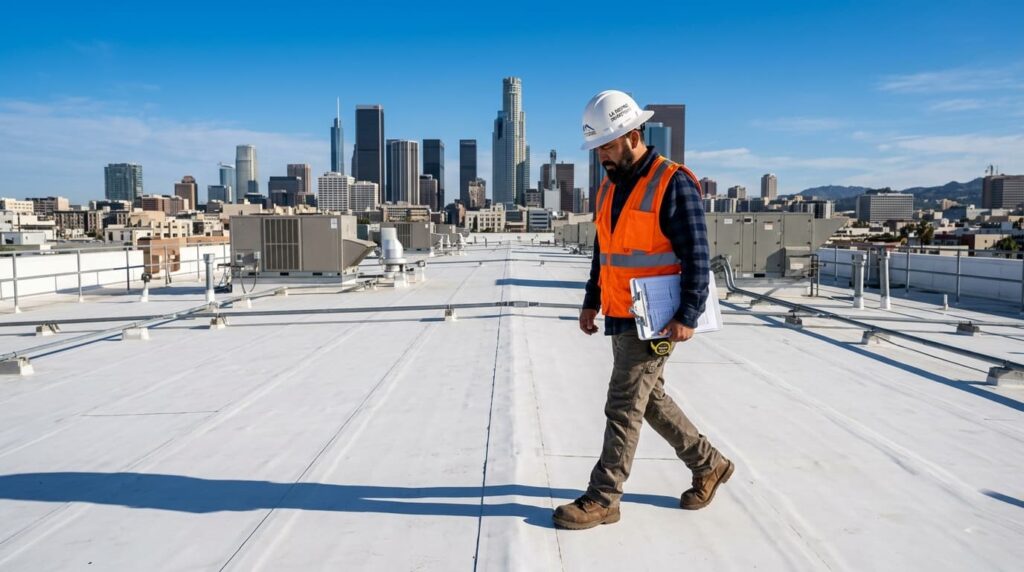
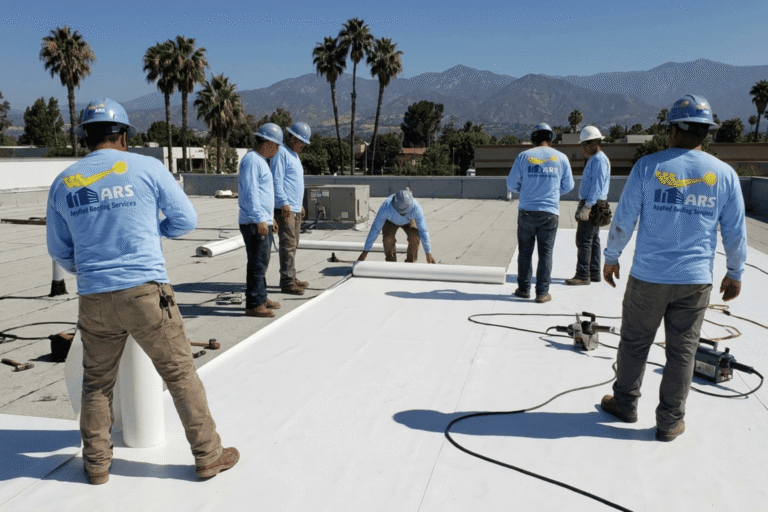
The most expensive commercial roof repair is the one that could have been avoided. Preventive roof maintenance is the single most cost-effective investment a commercial property owner or facility manager can make in the long-term performance of their building — and yet it remains one of the most consistently overlooked. Applied Roofing Services has been providing scheduled preventive maintenance programs for commercial roofing systems across Los Angeles County, Orange County, and the Inland Empire since 2003. We have seen firsthand, hundreds of times over, how a modest annual maintenance investment protects property owners from five- and six-figure emergency repair bills, premature roof replacements, and the business disruption that comes with an unexpected leak event.
This page covers everything you need to know about commercial preventive roof maintenance — what it involves, why it matters, what it costs, how Southern California’s specific climate affects your maintenance needs, and what a professional maintenance program from Applied Roofing Services actually includes. Whether you manage a single warehouse in Anaheim or a portfolio of commercial properties across greater Los Angeles, this information will help you make a more informed decision about protecting the assets in your care.
Schedule a Preventive Roof Inspection Today
Call our Los Angeles office: (213) 255-3677
Or request your free estimate online.
What Is Preventive Roof Maintenance — and What Does It Actually Include?
Preventive roof maintenance is a scheduled, systematic program of inspection, minor repair, and protective servicing performed on a commercial roofing system at regular intervals — before problems develop into failures. It is the roofing equivalent of changing the oil in a fleet vehicle rather than waiting for the engine to seize: structured, proactive, and far less expensive than the alternative.
For commercial buildings, a professional preventive maintenance visit typically encompasses the following activities:
Comprehensive Roof Inspection
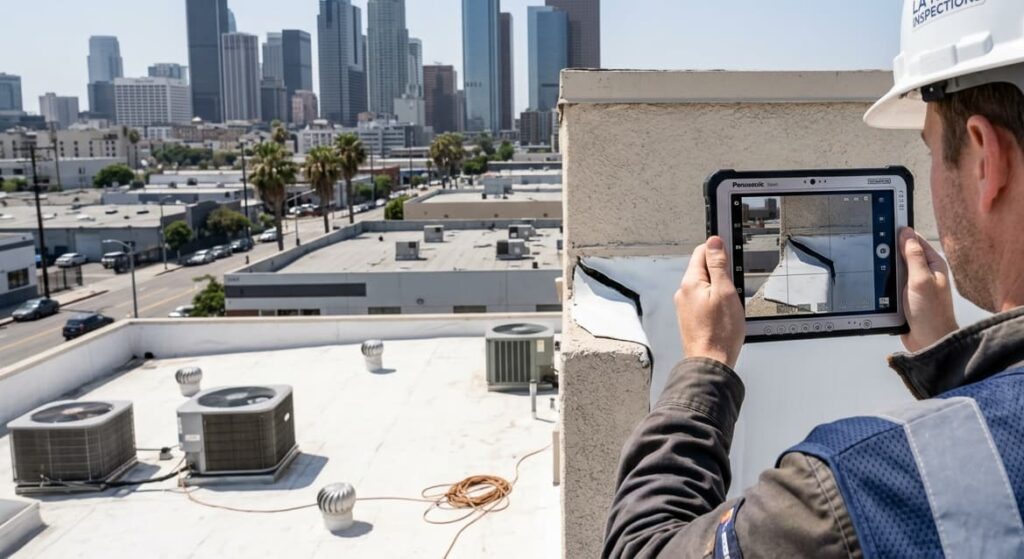
A licensed roofing technician walks the entire roof surface and evaluates every component of the system — the membrane or roof covering, all flashings, penetration seals, edge terminations, drains, scuppers, gutters, expansion joints, parapet walls, and rooftop equipment curbs. The inspection identifies current deficiencies, emerging conditions that haven’t yet become failures, and areas of wear that warrant monitoring. A written inspection report with photographs documents findings and provides a baseline record for future visits.
Drain and Scupper Clearing
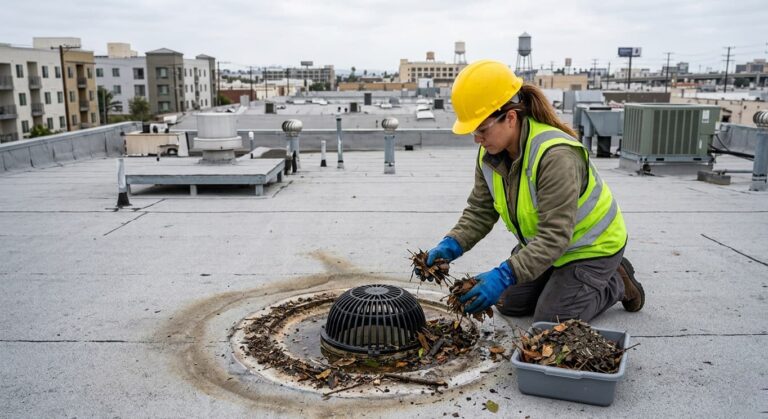
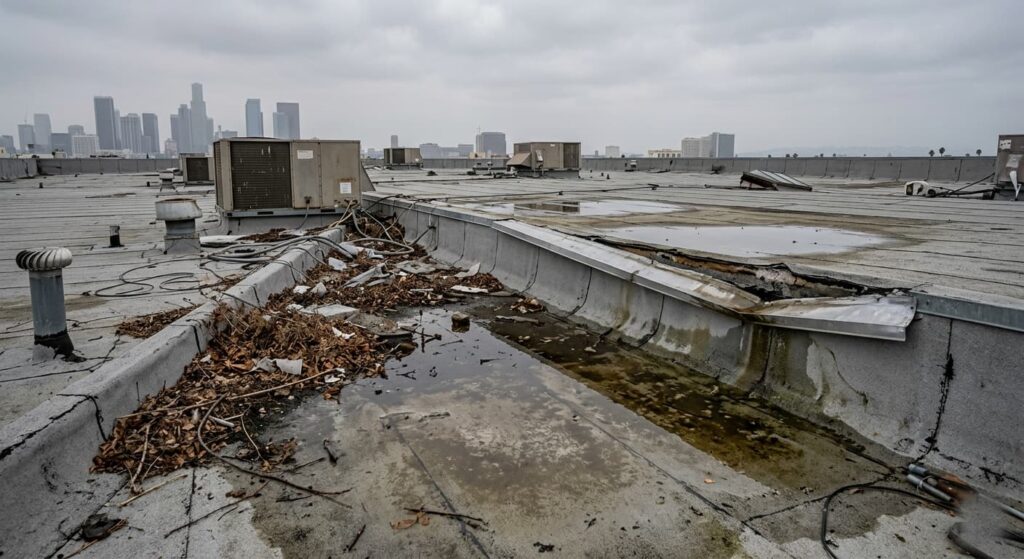
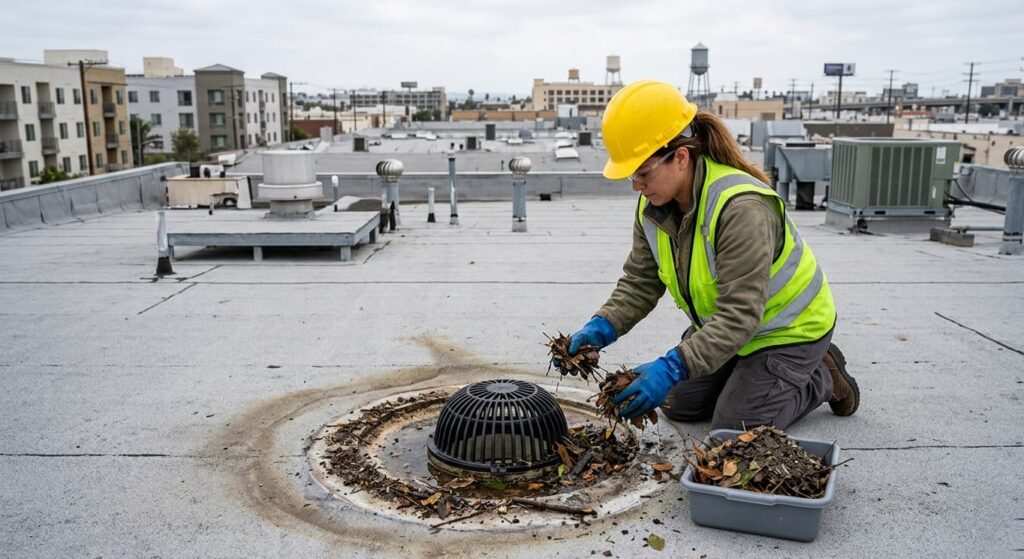
Blocked drains are one of the most common and most preventable causes of commercial roof damage. Debris accumulation — leaves, dirt, gravel ballast migration, bird nesting material, and HVAC condensate deposits — restricts drainage and causes ponding water that adds structural load, accelerates membrane deterioration, and creates ice damming risks in cold snaps. Every maintenance visit includes clearing all primary and secondary drains and scuppers of accumulated debris.
Minor Repair Work
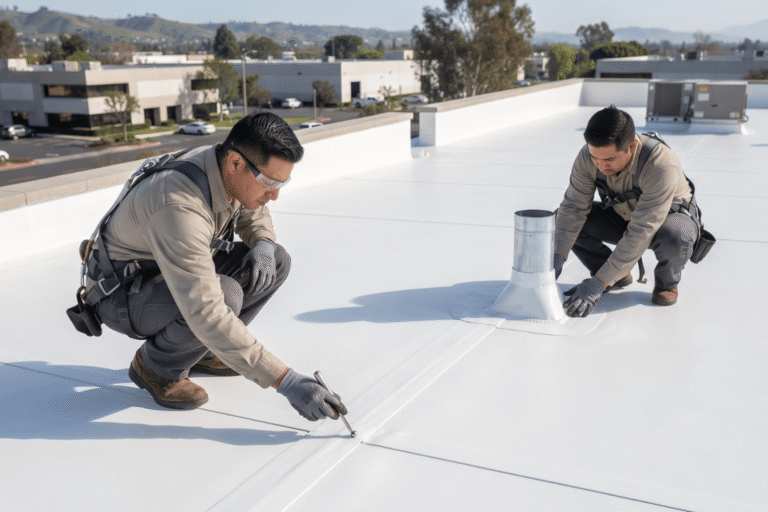
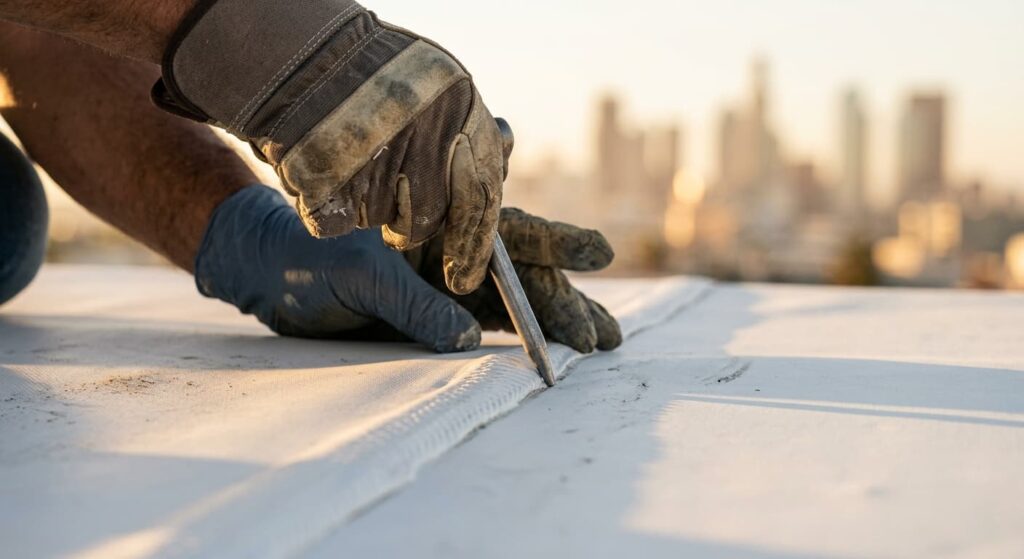
Identified deficiencies that fall within the scope of routine maintenance — small membrane blisters, minor flashing lifts, sealant degradation at penetrations, minor seam separations beginning to open — are addressed on the spot during the maintenance visit. Catching and correcting these conditions while they are small is the central value proposition of preventive maintenance: a $150 field seam repair during a scheduled visit prevents the $3,000 interior water damage claim that follows the same seam failing during a rainstorm six months later.
Sealant Inspection and Renewal
Sealants and caulks at penetrations, curbs, wall terminations, and edge metal are among the most common points of eventual water infiltration on commercial roofs. These materials have a finite service life — typically 5–10 years depending on product quality and UV exposure — and must be inspected and renewed before they fail rather than after. Preventive maintenance programs include a full sealant survey and topical renewal at identified locations.
Rooftop Equipment Area Inspection
HVAC units, skylights, exhaust fans, pipe penetrations, and any other rooftop equipment create concentrated foot traffic and flashing stress points that require focused attention. The areas around rooftop equipment are statistically the most frequent origin points for commercial roof leaks and receive detailed inspection during every maintenance visit.
Maintenance Report and Documentation
Every Applied Roofing Services maintenance visit concludes with a written report documenting the condition of each roof area, photographs of identified deficiencies, a record of any repairs performed, and recommendations for any work beyond routine maintenance scope. This documentation serves multiple purposes: it supports warranty compliance requirements, provides a paper trail that can support insurance claims, and gives property managers a professional record of stewardship for their assets.
The Financial Case for Preventive Roof Maintenance: What the Numbers Say
Property managers and building owners sometimes view preventive maintenance as a discretionary expense — something to cut when budgets are tight. The data consistently shows this perspective is exactly backwards. Preventive maintenance is not a cost center; it is a cost reduction strategy with a measurable and compelling return on investment.
The Cost of Reactive Roofing vs. Preventive Care
| Scenario | Reactive Approach (No Maintenance) | Preventive Approach |
|---|---|---|
| Failed flashing at HVAC curb | $4,000–$12,000 (repair + ceiling/insulation damage) | $200–$400 (sealant renewal caught at inspection) |
| Opening seam on TPO or PVC membrane | $2,500–$8,000 (emergency repair + interior damage) | $150–$300 (field seam re-weld at maintenance visit) |
| Blocked roof drain causing ponding | $3,000–$15,000 (membrane overstress, deck repair) | $0 (drain cleared during scheduled visit) |
| Foam roof without recoat (coating worn through) | $15,000–$40,000 (foam degradation, full recoat or replacement) | $3,000–$8,000 (timely recoat on schedule) |
| Roof system end of life (unmaintained) | 12–15 years (premature replacement) | 20–30 years (full design life achieved) |
The Industry Rule of Thumb: Research from the Facilities Net / Building Operating Management resource consistently cites that for every $1 invested in preventive roof maintenance, building owners avoid approximately $5–$8 in emergency repair and premature replacement costs. Applied Roofing Services has seen this ratio hold true across decades of work on Southern California commercial properties.
Manufacturer Warranty Compliance
Many commercial roofing manufacturer warranties — particularly 15- and 20-year system warranties on TPO, PVC, foam, and silicone systems — include a maintenance requirement as a condition of warranty validity. A warranty that requires professional inspections every two years and documents repairs to manufacturer-specified standards will be voided if a claim is submitted and the owner cannot demonstrate maintenance compliance. Applied Roofing Services provides maintenance documentation specifically formatted to support manufacturer warranty requirements, protecting your warranty coverage across its full term.
Southern California's Specific Threat Environment for Commercial Roofs
Preventive maintenance needs are not uniform across the country. A commercial roof in Minneapolis faces very different stressors than one in Los Angeles. Understanding Southern California’s specific threat environment helps property owners understand why maintenance matters here — and which elements of a maintenance program deserve the most attention.
UV Radiation — The Silent, Constant Threat
With over 280 sunny days per year, commercial roofs in Los Angeles and Orange County receive UV exposure that would be considered extreme in most U.S. climates. UV radiation breaks down the polymer chains in roofing membranes, oxidizes sealants and caulks, degrades adhesive bonds at flashing terminations, and — on spray foam roofs — deteriorates protective coatings that expose the underlying foam to accelerating damage. Annual maintenance inspections catch UV-driven degradation in its early stages, when intervention is inexpensive, rather than after it has progressed to membrane failure.
Santa Ana Wind Events
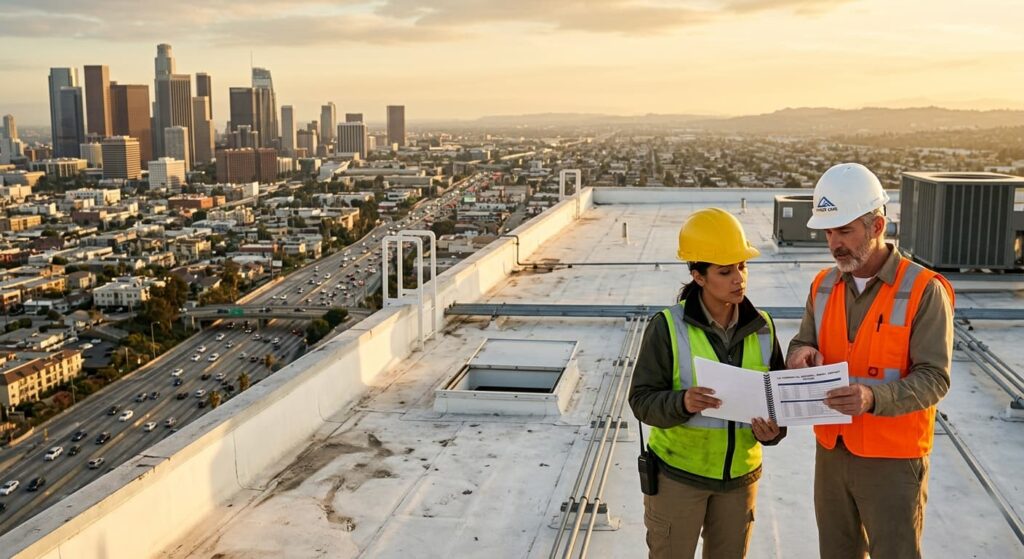
Santa Ana winds occur most intensely between October and March, generating sustained winds of 40–60 mph and gusts exceeding 80 mph across much of the LA Basin and Orange County. These events place extreme uplift forces on roofing membranes, particularly at edges, corners, and any area where the membrane has partially separated from its substrate. A maintenance inspection performed in late September — before Santa Ana season peaks — identifies and addresses these vulnerable conditions before they become wind-driven failures during an active event. Post-Santa Ana inspections in the spring identify any damage that occurred during the season.
El Niño Rainfall Events
Southern California’s rainfall is irregular and often intense during El Niño years. Heavy, concentrated rainfall events test drainage capacity, flashing integrity, and every seam and penetration on a commercial roof simultaneously. The problem is that most commercial roofs go years between significant rainfall events — long enough for sealant degradation, partial seam separation, and flashing movement to develop undetected, lying in wait for the next major rain to reveal themselves as leaks. A maintenance program performed consistently through dry years catches these developing conditions before rain arrives to expose them catastrophically.
Thermal Cycling in Inland Areas
Commercial properties in the San Fernando Valley, Inland Empire, and eastern Orange County experience daily temperature swings of 30–50°F during certain seasons — far more extreme than coastal locations. This thermal cycling drives repeated expansion and contraction in roofing materials, gradually fatiguing seams, flashings, and penetration seals over time. Properties in these higher-thermal-stress locations benefit from more frequent inspection intervals and more thorough sealant surveys during maintenance visits.
Biological Growth and Debris Accumulation
Southern California’s combination of warmth, coastal moisture, and irrigated landscaping creates favorable conditions for biological growth — algae, moss, and lichen — on rooftop surfaces and in drainage pathways. Biological growth holds moisture against roofing surfaces, accelerates material breakdown, and can physically root into membrane surfaces if left unaddressed. Debris accumulation from surrounding trees is a year-round issue on many commercial properties and requires attention during maintenance visits to prevent drainage system blockages.
Preventive Maintenance by Roofing System Type
Different commercial roofing systems have different maintenance requirements. Applied Roofing Services maintains expertise across all major commercial roofing systems installed throughout Southern California, and our maintenance programs are tailored to the specific needs of each system type rather than applying a one-size-fits-all checklist.
TPO and PVC Single-Ply Membrane Maintenance
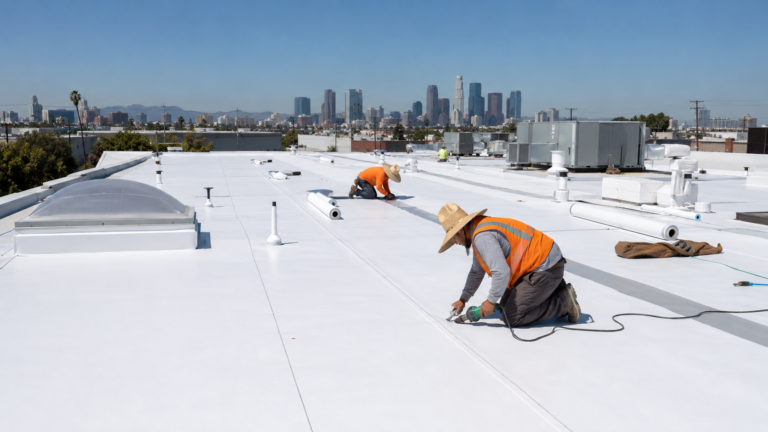
TPO and PVC roofs are among the most durable commercial systems available, but their performance depends on the continued integrity of heat-welded seams and mechanically terminated edge details. Preventive maintenance for single-ply systems focuses on seam probing to detect early delamination, flashing inspection at every penetration and edge termination, drain clearing, and membrane surface inspection for punctures or tears from foot traffic and falling debris. Early seam repair — before water infiltrates the insulation layer — is the maintenance activity with the highest ROI on single-ply systems. Learn more about our TPO and PVC roofing systems.
Spray Polyurethane Foam (SPF) Roof Maintenance
Spray foam roofs are uniquely dependent on the integrity of their protective coating layer — typically silicone or acrylic — which shields the underlying foam from UV degradation and physical damage. Without its protective coating, spray foam deteriorates rapidly, eventually requiring full replacement rather than simple recoating. Preventive maintenance for SPF systems includes coating thickness measurement, identification of granule loss or cracking in the coating surface, and documentation of the coating’s remaining serviceable life. A timely recoat — performed when the coating reaches minimum thickness before the foam is exposed — costs a fraction of what foam replacement requires. Learn more about our spray foam roofing systems.
Silicone Coating System Maintenance
Silicone-coated commercial roofs are exceptionally durable and require less frequent intervention than most other system types. Silicone is unaffected by ponding water and UV exposure. However, even silicone systems benefit from regular inspection to identify mechanical damage, flashing separation at edges and penetrations, and any areas where the coating has been abraded by foot traffic or equipment contact. Maintenance visits also provide the opportunity to document coating reflectance — important for both energy performance and warranty compliance — and identify any areas where reflectance has declined enough to warrant cleaning or recoating. Learn more about our silicone roofing systems.
Modified Bitumen and Built-Up Roofing Maintenance
Older commercial buildings in Los Angeles and Orange County frequently have modified bitumen or built-up roofing (BUR) systems that are 15–25 years old and approaching the end of their original design life. Preventive maintenance on these systems focuses on identifying alligatoring (surface oxidation cracking), blistering, membrane splits at seams or flashings, gravel ballast displacement, and drainage performance. Thorough documentation during maintenance visits also provides the data needed to determine whether the system is a good candidate for silicone coating restoration — potentially extending its life by 10–15 years — or whether full replacement is the more cost-effective path.
| Roofing System | Recommended Inspection Frequency | Key Maintenance Focus Areas | Critical Preventive Activity |
|---|---|---|---|
| TPO / PVC Single-Ply | Twice annually | Seam integrity, flashing, punctures, drains | Seam probing; early field repairs |
| Spray Polyurethane Foam | Annually (minimum) | Coating thickness, surface cracking, flashing, drains | Coating thickness monitoring; timely recoat scheduling |
| Silicone Coating Systems | Annually | Flashing integrity, mechanical damage, reflectance | Flashing renewal; reflectance documentation |
| Modified Bitumen / BUR | Twice annually | Alligatoring, blistering, seam splits, drainage | Early crack/blister repair; restoration feasibility assessment |
| EPDM | Twice annually | Seam adhesion, shrinkage, edge pull-back, flashing | Seam re-bonding; edge termination re-fastening |
The Applied Roofing Services Preventive Maintenance Program
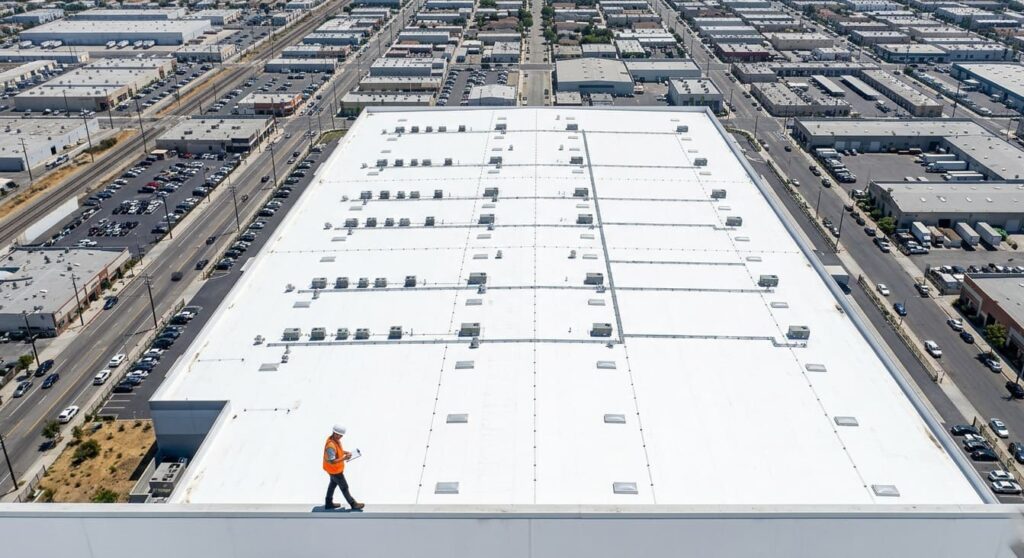
Applied Roofing Services offers structured preventive maintenance programs for commercial property owners and managers across Southern California. Our programs are designed around three core principles: thoroughness, documentation, and honest communication. Here is what our program looks like in practice:
Program Options
Annual Program: A single comprehensive inspection and maintenance visit per year, typically scheduled in the fall before California’s rainy season. Suitable for newer roofs in good condition, silicone-coated systems, and properties in lower-risk weather exposure areas. Includes full inspection, drain clearing, minor repairs, sealant survey, and written report.
Bi-Annual Program (Recommended for Most Commercial Properties): Two visits per year — one in September/October before Santa Ana and rain season, and one in April/May after winter weather has passed. The fall visit identifies and addresses vulnerabilities before rain season. The spring visit documents any weather-related damage, clears drainage of winter debris accumulation, and sets the maintenance baseline for the summer UV season. This schedule is Applied Roofing Services’ standard recommendation for the majority of Los Angeles and Orange County commercial properties.
Quarterly Program: Four visits per year, appropriate for high-value properties, buildings with complex rooftop systems, facilities under active manufacturer warranty with maintenance requirements, or properties that have had a history of leak events. Quarterly programs provide the tightest possible maintenance net and the earliest detection of developing conditions.
Custom Multi-Property Programs: For property management companies, REITs, and portfolio owners managing multiple commercial buildings, Applied Roofing Services offers consolidated maintenance programs that provide uniform coverage across all properties with centralized reporting. Portfolio programs can reduce per-property maintenance costs meaningfully through scheduling efficiency and provide a standardized documentation format for asset management purposes.
What Our Maintenance Reports Include
Every maintenance visit produces a written report that property owners and managers can rely on for budgeting, warranty compliance, and asset management purposes. Our reports include:
- Condition rating for each roof area and major component
- Photographic documentation of all identified deficiencies
- Record of all maintenance activities performed during the visit
- List of recommended repairs beyond routine maintenance scope, with priority classification
- Estimated remaining service life assessment
- Warranty compliance notation where applicable
Get a Custom Maintenance Program for Your Property
Los Angeles: (213) 255-3677
Inland Empire: (909) 361-6119
Or request your free maintenance assessment online →
Preventive Maintenance vs. Reactive Repairs: A Direct Comparison
The fundamental choice in commercial roof management is between a preventive posture — systematic, scheduled, proactive — and a reactive posture — responding to failures after they occur. Both approaches cost money. The difference is in how much, when, and under what circumstances that money is spent.
The Reactive Approach: Higher Cost, More Risk, Less Control
A property owner who manages their commercial roof reactively — calling a contractor only when a leak or visible damage appears — experiences a predictable pattern over time. Minor deficiencies that would have cost hundreds of dollars to address during a scheduled inspection instead develop into active failures that cause interior damage, disrupt tenants or operations, and generate emergency repair costs that are 5–10 times higher than the preventive intervention would have cost. The roof reaches replacement sooner than its design life because accumulated deferred maintenance compounds damage faster than timely maintenance would have allowed.
Reactive management also carries insurance and liability dimensions that property owners sometimes overlook. If an insurer or adjuster determines that a covered water damage event resulted from a pre-existing, unmaintained condition — and documented maintenance records cannot demonstrate otherwise — claim coverage can be reduced or denied. The Insurance Information Institute notes that thorough maintenance documentation is one of the most important factors in favorable commercial property claim outcomes.
The Preventive Approach: Lower Cost, More Control, Better Outcomes
A property owner with a preventive maintenance program spends money on a regular, predictable schedule — making maintenance a budgeted line item rather than an unpredictable emergency. Deficiencies are caught when they are small and inexpensive to address. The roof achieves its full design service life. Warranty coverage remains valid. Tenants experience fewer disruptions. Insurance claims, when they do occur, are supported by documentation that demonstrates proper stewardship of the property.
Preventive maintenance is particularly valuable for property managers responsible for multiple buildings. A portfolio managed proactively — with scheduled inspections, documented conditions, and prioritized repair queues — can be budgeted and managed efficiently. A portfolio managed reactively creates unpredictable capital demands, rushed contractor relationships, and the constant pressure of undocumented deferred liability.
Preventive Roof Maintenance Costs in Los Angeles & Orange County
One of the most common questions we hear from prospective clients is: what does a commercial roof maintenance program actually cost? The honest answer is that it depends on the size of the roof, the number of rooftop penetrations, the system type, and the frequency of visits. Here are realistic ranges for the Southern California market:
| Roof Size | Annual Program (1 visit) | Bi-Annual Program (2 visits) | Quarterly Program (4 visits) |
|---|---|---|---|
| Under 5,000 sq. ft. | $350 – $600 | $600 – $1,100 | $1,100 – $2,000 |
| 5,000 – 15,000 sq. ft. | $500 – $900 | $900 – $1,600 | $1,600 – $3,000 |
| 15,000 – 40,000 sq. ft. | $800 – $1,500 | $1,400 – $2,600 | $2,600 – $5,000 |
| 40,000 – 100,000 sq. ft. | $1,200 – $2,500 | $2,200 – $4,500 | $4,000 – $8,500 |
| 100,000+ sq. ft. | Custom pricing | Custom pricing | Custom pricing |
These figures represent the base program cost — professional inspection, drain clearing, minor maintenance activities, and written reporting. They do not include the cost of repairs identified during maintenance visits, which are quoted separately. In our experience, the vast majority of maintenance-identified issues are minor and inexpensive to address; any repair work that falls outside the routine maintenance scope is communicated to you with a clear price before work proceeds.
Multi-property portfolio programs are priced at a discount to individual property rates. Contact us for a portfolio-level assessment and consolidated pricing.
Put It in Perspective: The bi-annual maintenance program for a 20,000 sq. ft. commercial roof — approximately $1,800–$2,400 per year — represents less than 1.5% of the cost of replacing that roof ($150,000–$180,000). It is among the most asymmetric value propositions in commercial real estate management.
What Happens During a Preventive Maintenance Visit: A Step-by-Step Walkthrough
Property managers who have not worked with a maintenance-focused roofing contractor before sometimes wonder what a professional maintenance visit actually looks like on the ground. Here is a step-by-step walkthrough of what Applied Roofing Services does during a standard commercial preventive maintenance visit:
Pre-Visit Review
Before arriving on-site, our technician reviews the property’s maintenance history, prior inspection reports, any repair records, and the specific roofing system type and age. Properties enrolled in our maintenance program have a documented file that travels with every visit, allowing our team to focus attention on previously noted areas of concern and track condition changes over time rather than starting from scratch on every visit.
Roof Access and Safety Setup
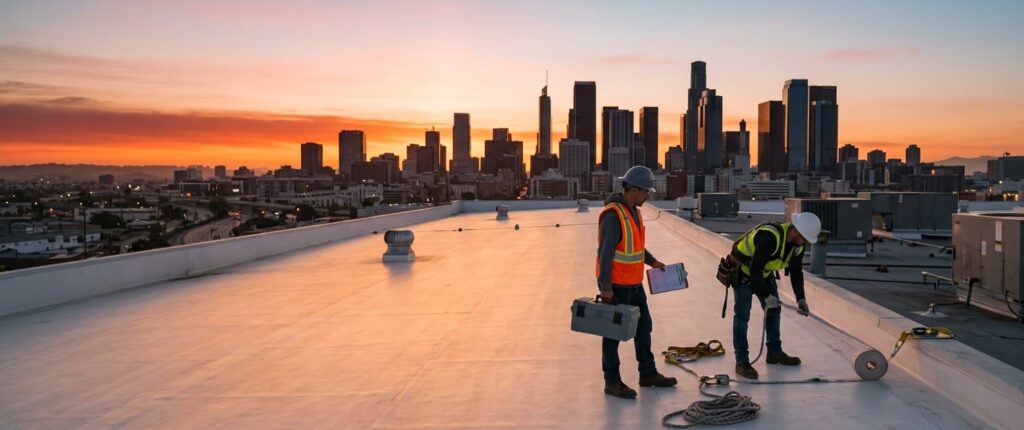
Our team arrives with all required safety equipment — harnesses, anchor systems, and edge protection where required by OSHA standards — and complies fully with all California Division of Occupational Safety and Health (Cal/OSHA) requirements for rooftop work. We coordinate access with the property manager or on-site contact and conduct a tailgate safety meeting before ascending.
Full Membrane Surface Walk
The technician walks the entire roof surface in a systematic pattern, inspecting the membrane or roof covering for blisters, punctures, tears, surface cracking, alligatoring, granule loss, debris accumulation, and evidence of ponding water marks. On single-ply systems, all visible seams are probed for adhesion continuity. The inspection is methodical — not a walk in the direction of the obvious concern — because minor conditions in untrafficked areas of the roof are exactly the ones most likely to have developed undetected.
Perimeter, Edge, and Parapet Inspection
The roof perimeter — where wind uplift forces are highest, where water is most likely to back up, and where thermal movement is most pronounced — receives focused attention. Edge metal condition, termination bar fastening, parapet wall flashing adhesion, counter-flashing integrity, and gravel stop or drip edge continuity are all evaluated.
Penetration and Flashing Detail Inspection
Every rooftop penetration is individually inspected: HVAC unit curbs, pipe boots, drain ring assemblies, skylight curbs, exhaust fans, conduit penetrations, and wall flashings. Sealant condition at every penetration is evaluated and flagged for renewal where degradation is identified. This phase of the inspection typically takes the most time on mechanically complex commercial rooftops and is the phase where the most maintenance-eligible conditions are discovered.
Drain and Drainage System Service
All primary roof drains, secondary overflow drains, and scuppers are cleared of debris accumulation. Drain dome strainers are removed, cleaned, and reinstalled. Drain bowl condition and clamping ring tightness are verified. Any evidence of drain bowl deterioration, improper pitch toward drains, or inadequate drainage capacity relative to the roof’s area is noted and reported.
Minor Repairs and Sealant Renewal
Identified conditions within routine maintenance scope — minor membrane repairs, sealant renewal at penetrations, small flashing adjustments — are addressed during the visit. Materials required for these minor repairs are carried on our maintenance vehicles as standard stock. Anything beyond routine maintenance scope is photographed, written up with a recommended repair description and estimated cost, and communicated to the property manager before we leave.
Report Delivery
Within a defined timeframe after the visit, the property manager receives a comprehensive written maintenance report covering all findings, all work performed, all recommended repairs with priority classifications, and updated condition documentation. This report becomes part of the property’s permanent maintenance file — building the documentation history that supports warranty compliance, insurance claims, and long-term capital planning.
Preventive Maintenance and Your Commercial Roof Warranty
A commercial roofing manufacturer warranty is only as valuable as the conditions under which it will actually be honored. Many property owners discover too late that their 15- or 20-year warranty included maintenance requirements they were unaware of — and that their claim has been denied because they cannot document compliance with those requirements.
The National Roofing Contractors Association (NRCA) strongly advises commercial property owners to read their manufacturer warranty carefully and understand what maintenance obligations it creates. Typical warranty maintenance requirements include:
- Professional inspection by a licensed contractor at intervals specified in the warranty (typically every 1–2 years)
- Prompt repair of identified deficiencies using manufacturer-specified materials and methods
- Written documentation of all inspection and repair activity maintained for the warranty term
- Notification to the manufacturer or warranty holder within a specified timeframe of any significant damage events
Applied Roofing Services maintains all necessary contractor credentials and manufacturer approvals to perform maintenance visits that satisfy warranty requirements for the roofing systems we install. For properties enrolled in our maintenance program, we manage the documentation trail that keeps warranty coverage valid — so that if a major failure occurs during the warranty term, the claim process is straightforward rather than contested.
Why Applied Roofing Services Is the Right Partner for Preventive Roof Maintenance in Southern California
A properly installed TPO roof is one of the lowest-maintenance commercial roofing systems available. That said, “low maintenance” is not the same as “no maintenance.” A basic maintenance program extends the life of your TPO system, preserves the validity of your manufacturer warranty, and keeps minor issues from becoming major ones.
Recommended TPO Maintenance Practices
- Biannual inspections: Professional inspections twice per year — ideally in the fall before winter rains and in the spring — allow early identification of developing issues: seam separations beginning to open, flashing lifting at edges, drain blockages forming, or membrane punctures from foot traffic or falling debris.
- Drain maintenance: Clear roof drains and scuppers of debris regularly to prevent ponding water from accumulating beyond the system’s design intent. Standing water is harmless to the membrane itself but adds structural load and can damage edge flashings if it backs up at perimeter details.
- Foot traffic protection: TPO is puncture-resistant but not impervious. Any regular foot traffic to rooftop HVAC equipment should travel on designated walkpad paths using approved TPO-compatible walkpad material — protecting the membrane from concentrated point loads and incidental sharp object contact.
- Prompt repair of identified issues: Small TPO repairs — a patch over a puncture, a re-weld of a seam beginning to separate — are fast and inexpensive when caught early. Left unaddressed, the same issues become leak events with associated interior damage costs that far exceed the repair.
Applied Roofing Services offers commercial roof maintenance programs for TPO and all other systems we install. A maintenance agreement ensures your roof is inspected on schedule, covered under a service relationship that provides priority response for any issues that arise, and kept in the condition required to maintain manufacturer warranty coverage.
Why Commercial Property Owners in Los Angeles & Orange County Choose Applied Roofing Services for TPO
Preventive maintenance is a long-term relationship, not a one-time transaction. The value of a maintenance program increases over time as your contractor builds a documented history of your roof’s condition, understands its specific vulnerabilities, and can track trends that are invisible to a first-time inspector. Here is what makes Applied Roofing Services the right partner for that relationship:
Two Decades of Southern California Roofing Experience
Applied Roofing Services has been maintaining commercial roofs across Los Angeles and Orange County since 2003. Our team has inspected and maintained roofs through multiple El Niño cycles, severe Santa Ana events, and the full range of Southern California’s weather extremes. That accumulated experience means our technicians recognize developing conditions faster, understand the regional failure patterns specific to our climate, and make maintenance recommendations grounded in what actually happens to roofs in this market over time.
All Systems, One Contractor
Many commercial properties in Southern California have roofing systems installed by multiple contractors over decades — a section of foam here, a TPO re-cover there, an older modified bitumen area still in service. Applied Roofing Services maintains expertise across all major commercial roofing systems, meaning a single maintenance program can cover every section of your roof without requiring separate contractors for different system types.
Licensed, Insured, and Accountable
Every maintenance visit is performed by licensed California roofing professionals under the full insurance coverage that protects you from liability. We are registered with the California Contractors State License Board (CSLB) and carry current general liability and workers’ compensation coverage. Before engaging any contractor for ongoing maintenance work, verifying active licensure and insurance is a fundamental due diligence step that protects your property from liability and ensures the work meets California code standards.
Transparent Pricing, No Upsell Pressure
Our maintenance programs are priced clearly and honestly. When our technicians identify conditions that require repair beyond routine maintenance scope, they photograph and document them thoroughly — and then present you with options and pricing clearly, without pressure. You make the decisions. Our job is to give you accurate information and quality work; not to manufacture urgency or inflate the repair scope.
“ARS has been my only foam roofing contractor for nearly 15 years. Their service is excellent and price competitive. I would recommend them highly.”
“Jeff and Jim Cardenas have always been responsive and easy to work with, have done what they said they would do, and gotten the job done within a reasonable amount of time.”
Preventive Maintenance Service Areas: Los Angeles, Orange County & the Inland Empire
Applied Roofing Services provides preventive roof maintenance programs for commercial properties throughout Southern California from three office locations. Our service area covers:
- Orange County: Anaheim, Orange, Santa Ana, Fullerton, Irvine, Costa Mesa, Huntington Beach, Garden Grove, Yorba Linda, Brea, Placentia, Tustin, Buena Park, Westminster, Cypress, La Habra, Stanton
- Los Angeles County: Los Angeles (DTLA, Hollywood, Koreatown, Mid-Wilshire, Van Nuys, El Segundo, Culver City), Burbank, Glendale, Long Beach, Torrance, Carson, Compton, El Monte, Pasadena, Pomona, West Covina, Inglewood, Hawthorne, Gardena
- Inland Empire: Rancho Cucamonga, Ontario, Fontana, Rialto, San Bernardino, Chino, Upland, Redlands, Colton, Montclair
Managing a property outside these core areas? Call us — if we can serve you, we will.
Protect Your Commercial Roof Investment — Contact Applied Roofing Services Today
A commercial roof is one of the largest single components of any building’s value — and one of the most consequential when it fails. Applied Roofing Services has spent over two decades helping commercial property owners across Los Angeles and Orange County protect that investment through disciplined, professional preventive maintenance programs that extend roof life, preserve warranty coverage, and eliminate the business disruption that comes with avoidable leak events.
Whether your building has never had a formal maintenance program, you are looking to switch from a contractor who isn’t delivering the documentation and responsiveness you need, or you are inheriting a property portfolio and need to get your roofs assessed and managed properly — Applied Roofing Services is ready to help. Our free initial assessment gives you a clear, honest picture of where your roof stands today and what it needs going forward.
The best time to start a preventive maintenance program is before a problem develops. The second best time is right now.
- Orange County: (714) 632-8418 — 1961 N. Main St., Orange, CA 92865
- Los Angeles: (213) 255-3677 — 1055 West 7th Street, 33rd Floor, Los Angeles, CA 90017
- Inland Empire: (909) 361-6119 — 8333 Foothill Blvd, Rancho Cucamonga, CA 91730
Or submit your property details online and we’ll be in touch to schedule your free initial assessment.
Explore our related services: Commercial Roof Repair & Maintenance · TPO & PVC Single-Ply Roofing · Spray Foam Roofing · Silicone Roof Coatings · Commercial Roof Replacement & Restoration
Frequently Asked Questions
How often should a commercial roof be inspected in Southern California?
The industry standard recommendation from the National Roofing Contractors Association is a minimum of two professional inspections per year for commercial roofs. In Southern California specifically, Applied Roofing Services recommends scheduling one inspection in September or October — before Santa Ana wind season and California’s rain season — and a second in April or May after winter weather has passed. High-value properties, roofs under active manufacturer warranty, and buildings with a history of leak events benefit from quarterly inspections.
What is the difference between preventive maintenance and a roof inspection?
A roof inspection is an evaluation only — a professional assesses the condition of the roof and provides a report, but performs no work. Preventive maintenance includes the inspection plus hands-on maintenance activities: drain clearing, minor repairs, sealant renewal, and other servicing tasks that address identified deficiencies on the spot. Applied Roofing Services’ maintenance program combines both into a single visit — you receive the documentation of an inspection and the protective value of actual maintenance work in the same appointment.
Will my commercial property insurance require roof maintenance?
Many commercial property insurance policies include a general requirement that the insured maintain the property in good repair — and roof maintenance is typically considered part of that obligation. While insurers rarely audit maintenance records proactively, they do examine maintenance history when a claim is submitted. Documented preventive maintenance records significantly strengthen your position in a claim situation, while the absence of maintenance history can provide grounds for reducing or denying coverage on damage claims where deferred maintenance is a contributing factor.
Can I perform roof maintenance myself, or do I need a licensed contractor?
Basic rooftop housekeeping — removing large debris from drains, for example — can be performed by building maintenance staff following appropriate safety protocols. However, professional maintenance that carries any value for warranty compliance, insurance documentation, or manufacturer warranty purposes must be performed by a licensed roofing contractor using appropriate materials and documented to professional standards. Rooftop work also carries significant fall hazard risk; Cal/OSHA requirements for rooftop safety are extensive, and building maintenance staff performing rooftop work without proper training and equipment creates serious liability exposure for property owners.
What happens if maintenance identifies a repair that needs immediate attention?
When our maintenance technician identifies a condition requiring repair beyond routine maintenance scope — an opening seam, a failing flashing, a drain bowl in need of replacement — they document it thoroughly with photographs and a written description, classify its urgency, and communicate it to the property manager before leaving the property. If the condition poses an active risk of water infiltration, we will advise you of that urgency clearly and provide a same-day or next-day repair response where needed. You decide whether and when to proceed; we give you the information to make that decision well.
Does a preventive maintenance program cover repairs, or only inspections?
Our maintenance programs include routine minor repairs — small membrane patches, sealant renewal, drain clearing — that fall within the scope of regular maintenance activity. They do not include major repairs such as significant membrane replacement, full flashing replacement, or structural work. When major repairs are needed, we quote them separately with clear itemized pricing. Our goal is that nothing our technician identifies during a maintenance visit comes as a financial surprise to you.
How do I start a preventive maintenance program with Applied Roofing Services?
The process begins with an initial roof condition assessment — a thorough inspection that establishes the baseline condition of your roof, identifies any pre-existing deficiencies that should be addressed before the maintenance program begins, and allows us to recommend the appropriate maintenance frequency and program type for your building. The initial assessment is provided free of charge for commercial property owners in our service area. Contact us by phone or through our website to schedule yours.
Can Applied Roofing Services maintain a roof they didn't install?
Yes. The majority of the commercial roofs we maintain were not installed by Applied Roofing Services — we are frequently brought in by new property owners, new property managers, or building owners who have never had a formal maintenance program in place. We can evaluate and maintain virtually any commercial roofing system, regardless of who installed it or when. The initial assessment tells us exactly what system you have, what condition it is in, and what maintenance approach is appropriate.