Thermoplastic Polyolefin (TPO) Roofing for Commercial Buildings in Los Angeles & Orange County
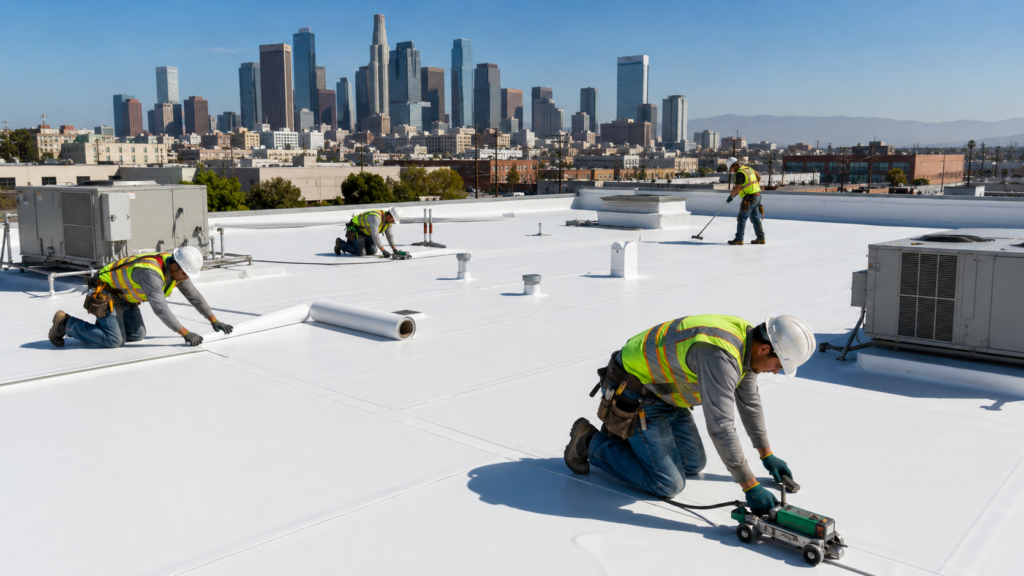
Thermoplastic polyolefin roofing has become the most widely specified commercial flat roofing membrane in the United States — and for good reason. TPO combines exceptional energy efficiency, long-term durability, and straightforward installation into a single-ply system that outperforms older technologies at a price point that makes financial sense for commercial property owners of all sizes. Applied Roofing Services has been installing TPO roofing systems across Los Angeles County, Orange County, and the Inland Empire since 2003, earning a reputation for precision craftsmanship, honest pricing, and industry-leading warranties that protect our clients’ investments for decades.
Whether you manage a warehouse, office building, retail strip center, industrial facility, or multi-tenant commercial property, thermoplastic polyolefin roofing may be the highest-performing and most cost-effective option for your next roof installation or replacement. This page covers everything you need to know — what TPO is, how it performs in Southern California’s specific climate, how it compares to alternatives, what it costs, and what to expect when you work with Applied Roofing Services on your project.
Ready for a Free TPO Roofing Estimate?
Call our Los Angeles office: (213) 255-3677
Or request your free estimate online.
What Is Thermoplastic Polyolefin (TPO) Roofing?
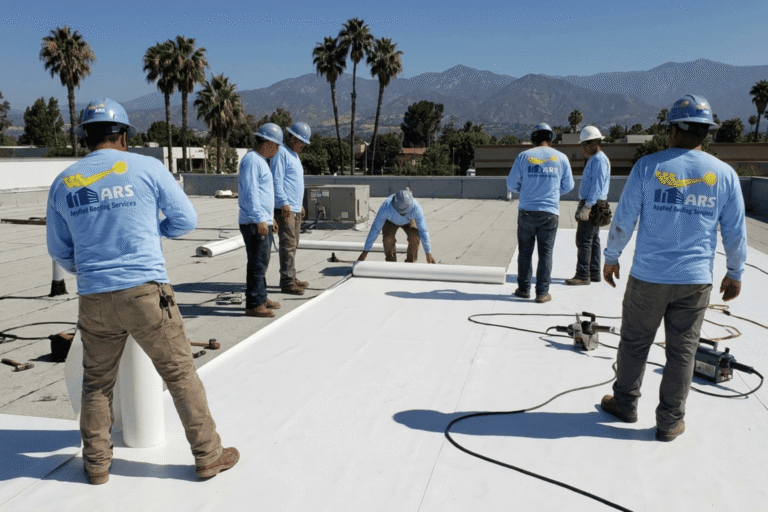
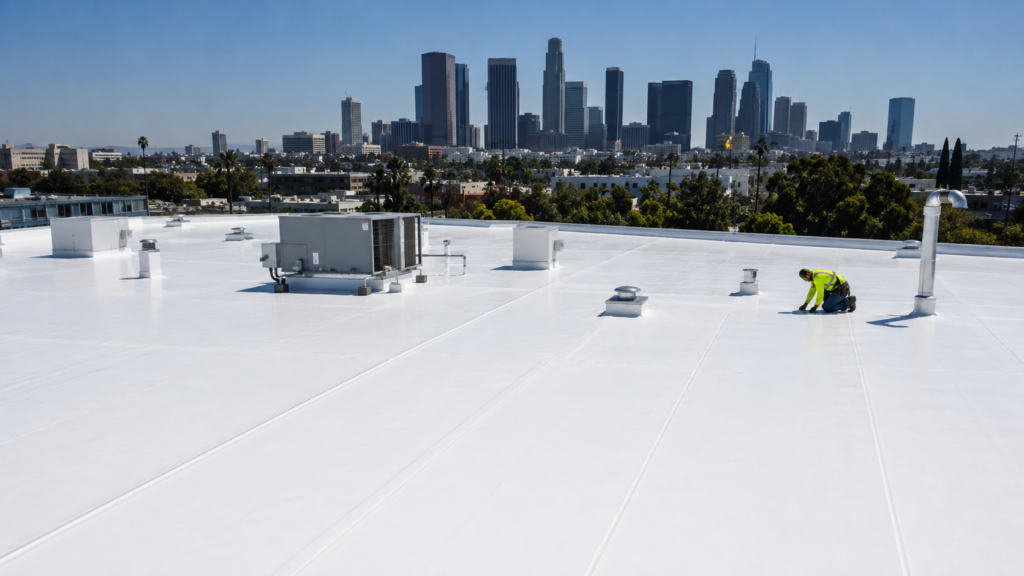
hermoplastic polyolefin is a single-ply roofing membrane composed of a blend of polypropylene and ethylene-propylene rubber, typically reinforced with a polyester scrim or fiberglass mat for dimensional stability. TPO membranes are manufactured in rolls and installed over commercial roof decks as a continuous, flexible sheet, with seams between rolls joined using a hot-air welding process that fuses the material into a single monolithic surface.
TPO is classified as a “thermoplastic” membrane because it can be repeatedly softened by heat and re-hardened upon cooling — a property that makes hot-air seam welding possible and gives the material a degree of self-healing flexibility that thermoset materials like EPDM do not offer. The result is a roofing system with no mechanical fastener penetrations through the membrane field, minimal weak points, and seam strengths that often exceed the strength of the membrane itself when properly installed.
According to the Single Ply Roofing Industry (SPRI), TPO now accounts for approximately 40–50% of all single-ply commercial roofing installations in the United States, making it the market’s dominant membrane by volume — a position it has held for over a decade. In California, where Title 24 energy efficiency requirements effectively mandate cool roofing on commercial buildings, TPO’s inherently high solar reflectance makes it the natural first choice for most new construction and replacement projects.
TPO at a Glance: A white or light-colored thermoplastic single-ply membrane for flat and low-slope commercial roofs. Heat-welded seams. High solar reflectance (typically 0.79–0.87 initial). ENERGY STAR rated. Title 24 compliant. 15–20 year manufacturer warranties. Recyclable at end of life. Appropriate for virtually all commercial building types.
Why TPO Roofing Performs Exceptionally Well in Southern California
Extreme UV Resistance
Los Angeles and Orange County receive over 280 days of sunshine annually. For conventional dark roofing materials, this level of UV exposure accelerates oxidation, causes membrane brittleness, and breaks down the chemical bonds in surface coatings. TPO’s white surface reflects rather than absorbs solar radiation, dramatically reducing the UV degradation that shortens the lifespan of conventional roofing systems. Modern TPO formulations also incorporate UV stabilizers directly into the membrane compound, providing protection against UV degradation throughout the material’s full thickness — not just at the surface.
Thermal Cycling Resistance
Southern California commercial roofs experience significant daily temperature swings, particularly in the Inland Empire and San Fernando Valley areas where daytime highs can exceed 100°F in summer while overnight temperatures drop into the 60s. This thermal cycling — the repeated expansion and contraction of roofing materials — is a primary cause of seam failure, membrane cracking, and flashing separation in less flexible systems. TPO’s thermoplastic nature gives it superior flexibility across a wide temperature range, accommodating thermal movement without the stress cracking that affects more rigid materials.
Wind Uplift Performance
Santa Ana wind events generate sustained winds of 40–60 mph and gusts that can exceed 80 mph across much of the Los Angeles Basin and Orange County. TPO roofing systems installed using mechanically fastened or fully adhered methods achieve FM Global wind uplift ratings that meet or exceed the requirements for Southern California’s wind exposure categories. The FM Global approvals process is the industry’s most rigorous standard for wind uplift resistance, and Applied Roofing Services installs TPO systems to FM-approved specifications on every eligible project.
Occasional Heavy Rainfall & Ponding Water Tolerance
El Niño years bring intense rainfall events that can overwhelm flat roof drainage systems, leaving standing water on rooftop surfaces for extended periods. Unlike some roofing materials that degrade when exposed to prolonged ponding, TPO membranes maintain their structural integrity under ponding water conditions and do not support algae or biological growth that can degrade other membrane types over time.
The Key Technical Advantages of TPO Roofing
Understanding why thermoplastic polyolefin roofing outperforms alternatives requires a closer look at the technical properties that define the material’s performance. Here are the characteristics that matter most for commercial building owners:
Solar Reflectance & Thermal Emittance — The Cool Roof Advantage
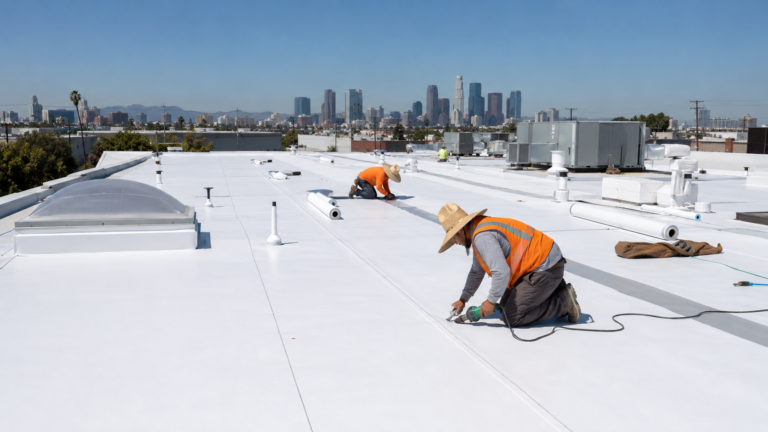
Standard white TPO membranes achieve initial solar reflectance values of 0.79–0.87, meaning they reflect 79–87% of incoming solar radiation back into the atmosphere rather than absorbing it as heat. Combined with thermal emittance values typically above 0.90, white TPO qualifies as a cool roof under both ENERGY STAR standards and California’s Title 24 cool roof requirements. The practical result is measurable — rooftop surface temperatures under a white TPO membrane can run 50–80°F cooler than under a conventional black EPDM or modified bitumen surface on a hot summer day, directly reducing the heat load transferred into the building below.
Heat-Welded Seam Integrity
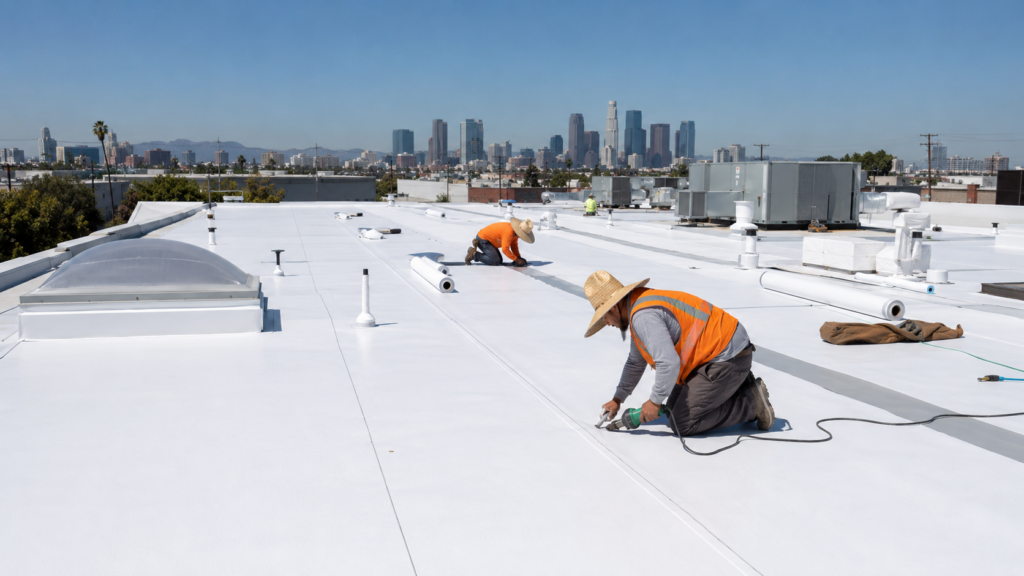
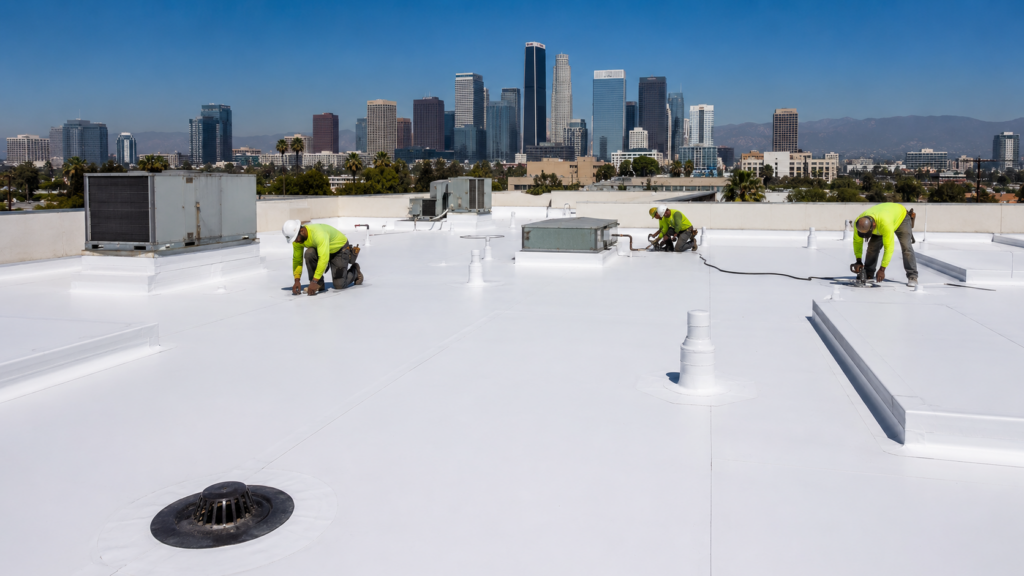
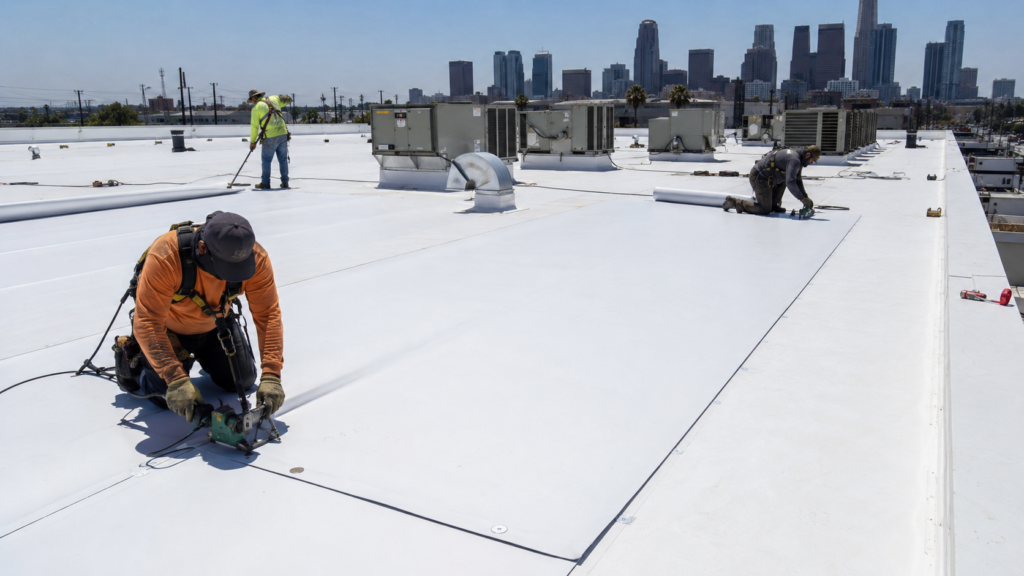
The defining installation characteristic of TPO is its hot-air welded seam system. Unlike adhesive or tape-based seaming methods used with some other membranes, TPO seams are created by fusing the membrane material itself using a hot-air welding machine that melts the overlapping layers together into a homogeneous bond. Properly welded TPO seams routinely achieve peel strengths of 10–30 pounds per inch of seam width — often stronger than the surrounding membrane — creating a waterproofing system with no chemically bonded joints that can deteriorate over time.
Chemical Resistance
TPO membranes offer good resistance to a broad range of chemicals, oils, and biological matter. While not as chemically inert as PVC in extreme environments, modern TPO formulations handle the types of rooftop chemical exposure typically encountered on commercial buildings — HVAC condensate, mild cleaning agents, and incidental oil or grease contact — without membrane degradation.
Recyclability
At the end of its service life, TPO membrane can be recycled rather than landfilled. Some manufacturers operate take-back programs that collect and recycle old TPO membrane. This recyclability is a meaningful environmental advantage over thermoset materials like EPDM, which cannot be remelted and reformed. For property owners pursuing LEED certification or green building credentials, TPO’s recyclability is a relevant materials credit under multiple LEED rating systems.
Dimensional Stability
TPO membranes reinforced with polyester or fiberglass scrim exhibit very low rates of thermal shrinkage — a critical property for long-term roof performance. Membrane shrinkage over time is a primary cause of flashing pull-away at roof edges and penetrations, creating leak pathways that are difficult and expensive to address. High-quality TPO products from established manufacturers maintain dimensional stability across decades of service, protecting the integrity of edge and penetration terminations throughout the membrane’s design life.
TPO vs. EPDM vs. PVC: Choosing the Right Single-Ply Membrane
TPO is one of three dominant single-ply membrane types in the commercial roofing market, alongside EPDM (ethylene propylene diene monomer) and PVC (polyvinyl chloride). Understanding how they compare helps commercial property owners make an informed decision — and helps explain why TPO has become the preferred choice for most Southern California commercial applications.
| Feature | PVC | TPO | EPDM |
|---|---|---|---|
| Lifespan | 20–30 years | 15–20 years | 15–25 years |
| UV Resistance | Excellent | Good | Moderate |
| Chemical Resistance | Excellent (grease, oils, acids) | Poor (breaks down with oils) | Good |
| Title 24 / Cool Roof | Naturally compliant (white) | White option available | Typically black; poor reflectance |
| Seam Strength | Heat-welded (strongest) | Heat-welded | Adhesive/taped (weakest) |
| Solar Compatibility | Excellent (80-mil available) | Good | Fair |
| Cost per Sq Ft (2026) | $7–$12 | $5–$10 | $4–$8 |
| Best For | Restaurants, industrial, solar-ready | General commercial | Low-budget, simple builds |
For the vast majority of commercial properties in Los Angeles and Orange County, TPO delivers the best combination of energy performance, seam integrity, durability, and cost. The primary exception is facilities with significant rooftop grease or chemical exposure — restaurants, food processing plants, and certain manufacturing environments — where PVC’s superior chemical resistance justifies its higher cost. Applied Roofing Services will always give you an honest recommendation based on your specific building and use case, not on which product carries a higher margin.
California Title 24 & ENERGY STAR: What TPO Compliance Means for Your Building
California operates the most stringent commercial building energy efficiency regulations in the United States. For commercial roofing, the relevant framework is Title 24 Part 6 — the California Building Energy Efficiency Standards — which mandates cool roof requirements on new and replacement low-slope commercial roofs throughout the state.
Title 24 Cool Roof Requirements for Commercial Buildings
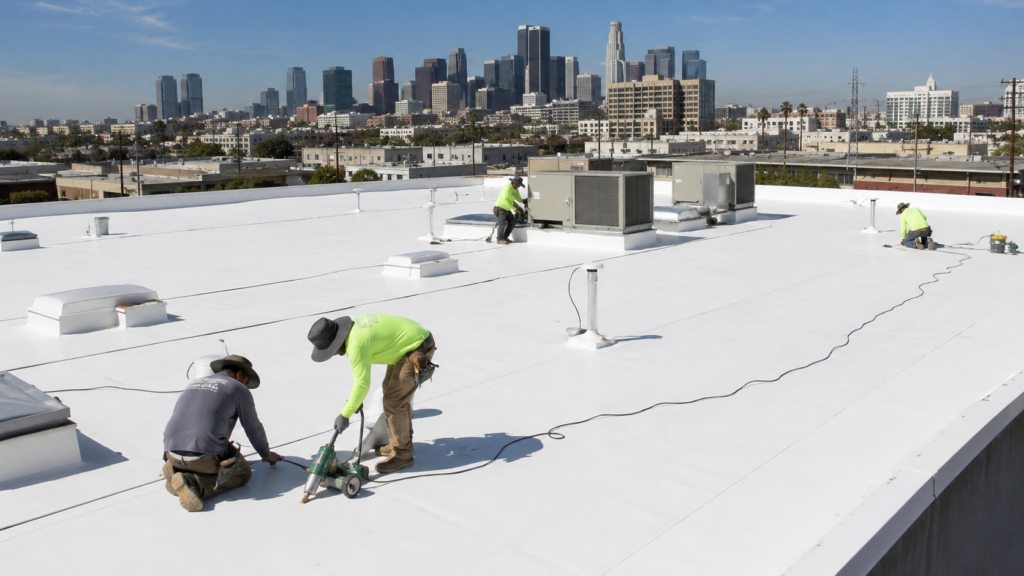
For low-slope commercial roofs (slope less than 2:12), California’s Title 24 requires a minimum initial solar reflectance of 0.63 and thermal emittance of 0.75, as rated by the Cool Roof Rating Council (CRRC) — the independent body that certifies roofing product performance data. Standard white TPO membranes from all major manufacturers exceed these thresholds by a meaningful margin, making them inherently compliant without requiring special formulations or additional coatings.
Compliance with Title 24 is not optional. Roofing work that does not meet cool roof requirements can result in failed building inspections, required tear-off and replacement at the owner’s expense, and delays in certificate of occupancy issuance for new construction. Applied Roofing Services handles Title 24 documentation, CRRC product verification, and inspection coordination as a standard part of every commercial TPO installation we perform.
ENERGY STAR Certification
The ENERGY STAR Roof Products program certifies commercial roofing membranes that meet minimum reflectance thresholds — an initial solar reflectance of at least 0.65 for low-slope products. ENERGY STAR certification supports utility rebate applications, contributes to LEED point accumulation, and provides independent third-party verification of product performance claims. All of the TPO products Applied Roofing Services installs carry current ENERGY STAR certification.
Utility Rebates for TPO Cool Roofs in Southern California
Southern California Edison offers rebates for qualifying energy efficiency improvements under its Business Energy Solutions program. Depending on the project scope and current program availability, TPO cool roof installations on qualifying commercial properties may be eligible for per-square-foot rebates that offset a portion of your installation cost. Our team can help you identify applicable rebate programs before your project begins so you can factor incentives into your budget planning.
TPO Roofing Installation Methods: Fully Adhered, Mechanically Fastened & Ballasted
TPO membranes can be installed using three primary attachment methods, each with distinct advantages depending on the building structure, existing roof conditions, local wind uplift requirements, and budget. Applied Roofing Services evaluates all three methods for every project and recommends the approach that best balances performance, longevity, and cost for your specific building.
Fully Adhered (Bonded) Installation
In a fully adhered installation, the TPO membrane is bonded directly to the roof insulation layer using a compatible bonding adhesive, creating uniform attachment across the entire membrane surface. Fully adhered systems offer the highest wind uplift resistance, the most uniform appearance, and the greatest resistance to membrane billowing or flutter in high-wind conditions. This method is generally preferred for buildings in Southern California’s higher wind exposure zones and for projects where rooftop aesthetics matter. It carries a higher installation cost than mechanically fastened methods due to the additional labor and adhesive material involved.
Mechanically Fastened Installation
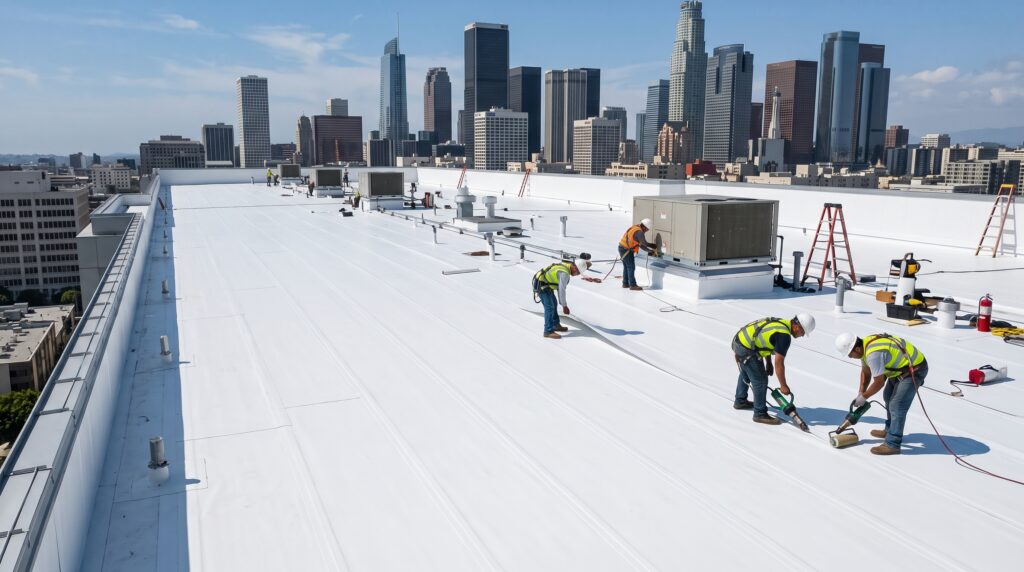
Mechanically fastened TPO systems use rows of metal fastener plates or stress plates installed under the membrane seams, securing the membrane to the structural deck through the insulation layer. This method is faster to install, costs less than fully adhered systems, and provides excellent performance across the range of wind conditions typical in most Southern California locations. It is the most commonly specified installation method for commercial TPO roofing and is appropriate for the majority of warehouse, industrial, and retail applications in Los Angeles and Orange County.
Ballasted Installation
Ballasted TPO systems use the weight of rounded river gravel or concrete pavers to hold the membrane in place, with minimal mechanical attachment. This method is the fastest and lowest-cost installation approach and eliminates fastener penetrations through the deck entirely. However, ballasted systems add significant dead load to the roof structure (typically 10–12 lbs. per square foot), require a structural assessment to confirm the building can support the additional weight, and are generally not recommended for high-wind exposure areas. Applied Roofing Services evaluates structural capacity and wind exposure before recommending ballasted installation on any project.
What Does TPO Roofing Cost in Los Angeles & Orange County?
Pricing transparency matters. Here is a realistic breakdown of what commercial TPO roofing costs in Southern California, based on current material and labor conditions in the Los Angeles and Orange County markets:
| Repair Type | Estimated Cost Range | Key Variables |
|---|---|---|
| Emergency tarping / temporary stabilization | $500 – $2,500 | Roof area, accessibility, material needed |
| Small membrane patch (under 100 sq. ft.) | $400 – $1,500 | System type, depth of damage, labor access |
| Seam repair (TPO, PVC, EPDM) | $300 – $1,200 per seam | Number of failed seams, membrane condition |
| Flashing replacement (penetrations, edges, walls) | $500 – $3,000 | Linear footage, flashing type, substrate condition |
| Foam system crack repair + recoating | $800 – $4,000 | Damage area, coating product, access |
| Drain repair or replacement | $400 – $1,800 per drain | Drain type, deck condition, ponding severity |
| Large-scale emergency repair (storm damage, full section) | $5,000 – $25,000+ | Scope, system type, structural involvement |
These ranges reflect installed costs including materials, labor, flashing work, penetration detailing, and standard cleanup. They do not include structural repairs, drain modifications, or HVAC unit curb work, which are priced separately if needed and always communicated to you before work begins.
Factors That Affect Your TPO Project Cost
- Roof size: Larger projects benefit from material and mobilization economies that reduce per-square-foot cost meaningfully. A 50,000 sq. ft. project costs considerably less per square foot than a 5,000 sq. ft. project.
- Roof access & height: High-rise or difficult-access roofs require additional equipment and safety measures that add to project cost.
- Number of penetrations: Each HVAC unit, pipe boot, drain, and roof curb requires individual flashing detail work. A mechanically complex rooftop with dozens of penetrations takes more labor than a clean, open deck.
- Insulation requirements: Title 24’s minimum insulation R-value requirements for commercial roofs mean that older buildings may require insulation upgrades during the roofing project — an added cost that also pays back in reduced energy bills.
- Membrane thickness: TPO membranes are available in 45-mil, 60-mil, and 80-mil thicknesses. Heavier gauges cost more but provide greater puncture resistance, longer service life, and stronger seam performance. Applied Roofing Services typically recommends 60-mil as the minimum for commercial applications.
Warranty Matters: Applied Roofing Services installs TPO roofing systems from industry-leading manufacturers and can provide manufacturer-backed warranties of up to 20 years on qualifying installations. A contractor offering a dramatically lower price is almost certainly using thinner membrane, lesser-known products with no manufacturer warranty support, or cutting corners on seam quality and flashing detail. Always ask what warranty comes with the installation — not just the material.
The Applied Roofing Services TPO Installation Process
A TPO roof is only as good as the installation that puts it in place. The membrane itself is a commodity — the expertise lies in the preparation, detailing, seam quality, and warranty backing that a skilled contractor provides. Here is what our process looks like from first contact to final sign-off:
Step 1: Free Roof Assessment & Scope Development
We begin with a thorough inspection of your existing roof — evaluating the substrate condition, insulation adequacy, drainage performance, and current penetration details. We identify any issues that need to be addressed before new membrane goes down, document everything clearly, and develop a detailed scope of work. You receive a written estimate that accounts for every element of the project, with no surprises once work begins.
Step 2: Substrate Preparation
Proper surface preparation is the foundation of a long-performing TPO installation. We address any substrate irregularities, repair or replace damaged insulation, verify that drains are clear and properly sloped, and ensure that all penetration curbs and edge details are structurally sound before membrane installation begins. Cutting corners here is where lesser contractors create the conditions for premature failure.
Step 3: Insulation & Cover Board Installation (Where Required)
For projects requiring new insulation, we install the appropriate R-value polyisocyanurate (polyiso) insulation boards — the most common commercial roofing insulation for California projects due to its high R-value per inch and compatibility with both Title 24 requirements and TPO adhesive systems. A cover board layer is often installed over the insulation to provide a smooth, stable substrate for membrane adhesion and to protect the insulation from foot traffic during and after installation.
Step 4: Membrane Installation & Seam Welding
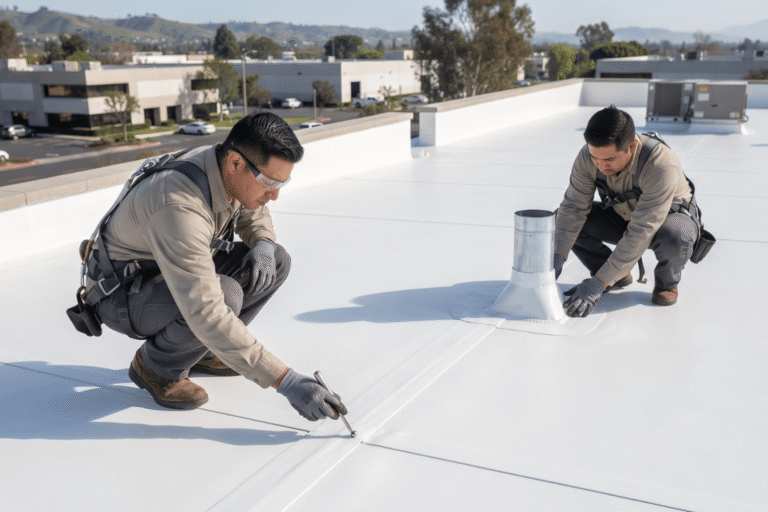
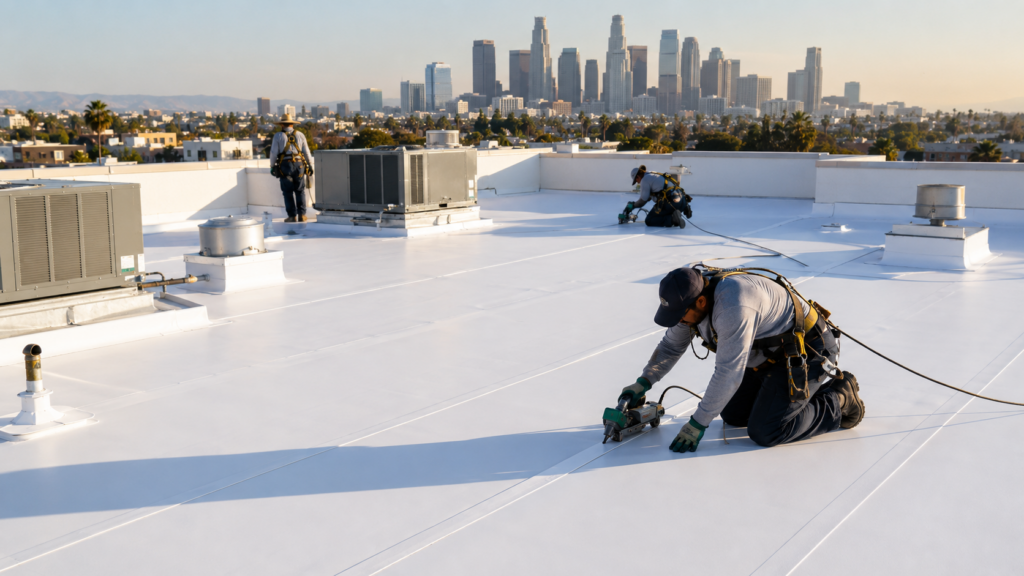
TPO membrane rolls are positioned, aligned, and secured using the appropriate attachment method (adhered, fastened, or ballasted) for the project specification. Seams are hot-air welded using calibrated automatic welding machines supplemented by hand-held welders at complex details, corners, and penetrations. Seam welds are tested using a probe tool to verify continuous fusion across every linear foot of seam — a quality control step that separates professional commercial installations from low-bid work.
Step 5: Flashing, Edge & Penetration Detailing
Flashing is where most roof failures begin. Every penetration — HVAC curbs, pipe boots, drains, skylights, wall terminations, and roof edges — receives individual attention using manufacturer-specified TPO flashing materials and detail methods. Applied Roofing Services treats flashing as the most critical phase of every installation, because a technically perfect field membrane with a single compromised flashing detail is still a leaking roof.
Step 6: Final Inspection & Documentation
Before we leave your property, we conduct a comprehensive final inspection — verifying seam continuity, flashing integrity, drain function, and edge termination security. We provide you with written documentation of the completed work, material specifications, and warranty registration information. For projects requiring Title 24 compliance documentation, we provide all necessary certifications for your permit and inspection files.
TPO Roofing Maintenance: What It Takes to Protect a 20-Year Investment
A properly installed TPO roof is one of the lowest-maintenance commercial roofing systems available. That said, “low maintenance” is not the same as “no maintenance.” A basic maintenance program extends the life of your TPO system, preserves the validity of your manufacturer warranty, and keeps minor issues from becoming major ones.
Recommended TPO Maintenance Practices
- Biannual inspections: Professional inspections twice per year — ideally in the fall before winter rains and in the spring — allow early identification of developing issues: seam separations beginning to open, flashing lifting at edges, drain blockages forming, or membrane punctures from foot traffic or falling debris.
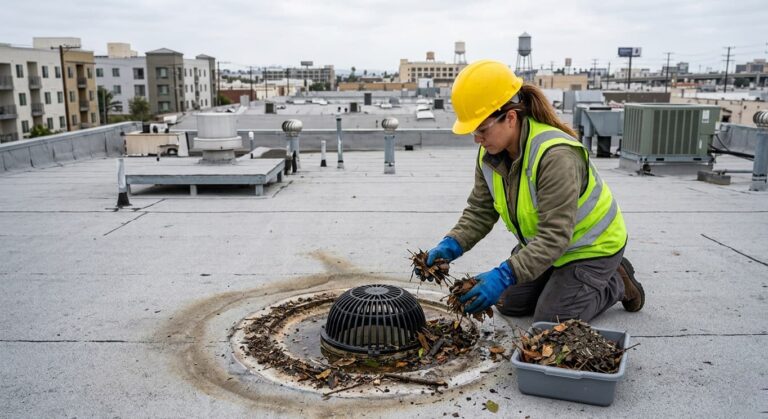
- Drain maintenance: Clear roof drains and scuppers of debris regularly to prevent ponding water from accumulating beyond the system’s design intent. Standing water is harmless to the membrane itself but adds structural load and can damage edge flashings if it backs up at perimeter details.
- Foot traffic protection: TPO is puncture-resistant but not impervious. Any regular foot traffic to rooftop HVAC equipment should travel on designated walkpad paths using approved TPO-compatible walkpad material — protecting the membrane from concentrated point loads and incidental sharp object contact.
- Prompt repair of identified issues: Small TPO repairs — a patch over a puncture, a re-weld of a seam beginning to separate — are fast and inexpensive when caught early. Left unaddressed, the same issues become leak events with associated interior damage costs that far exceed the repair.
Applied Roofing Services offers commercial roof maintenance programs for TPO and all other systems we install. A maintenance agreement ensures your roof is inspected on schedule, covered under a service relationship that provides priority response for any issues that arise, and kept in the condition required to maintain manufacturer warranty coverage.
Why Commercial Property Owners in Los Angeles & Orange County Choose Applied Roofing Services for TPO
There are dozens of roofing contractors in Southern California who will give you a price on a TPO roof. Here is what separates Applied Roofing Services from the field:
Over Two Decades of Commercial Roofing Experience
Applied Roofing Services has been operating in the Southern California commercial roofing market since 2003. That longevity matters: it means we have installed TPO roofing through multiple El Niño cycles, Santa Ana wind seasons, and Southern California construction booms — and our installed roofs have been tested by real Southern California weather. Contractors who have been in business for a few years haven’t had time to prove whether their installations hold up over the long term.
Licensed, Insured & CRRC-Certified
Applied Roofing Services is a fully licensed California roofing contractor. We carry full general liability and workers’ compensation insurance on every project, protecting you from exposure in the event of an on-site incident. Our products are certified by the Cool Roof Rating Council (CRRC), ensuring that the reflectance values we represent to you and your building inspector are independently verified — not self-reported marketing claims.
Industry-Leading Manufacturer Warranties
We install TPO from the commercial roofing industry’s most established manufacturers and can offer manufacturer-backed warranties of up to 20 years on qualifying projects. These warranties cover both the material and the installation workmanship — meaning if there is a failure attributable to material defect or seam performance within the warranty period, the manufacturer stands behind the repair. Low-bid contractors using off-brand or gray-market membrane products simply cannot offer this protection.
No-Surprise Pricing
We provide itemized written estimates before any work begins. The price we quote is the price you pay, subject only to changes in project scope that we communicate and agree with you in writing before proceeding. Property managers and building owners who have been burned by change-order-heavy contractors consistently tell us this is one of the things they value most about working with Applied Roofing Services.
“ARS has been my only foam roofing contractor for nearly 15 years. Their service is excellent and price competitive. I would recommend them highly.”
“Jeff and Jim Cardenas have always been responsive and easy to work with, have done what they said they would do, and gotten the job done within a reasonable amount of time.”
TPO Roofing Service Areas: Los Angeles, Orange County & the Inland Empire
Applied Roofing Services installs thermoplastic polyolefin roofing systems for commercial properties throughout Southern California from three office locations, providing the geographic reach of a regional contractor with the service responsiveness of a local one:
- Orange County: Anaheim, Orange, Santa Ana, Fullerton, Irvine, Costa Mesa, Huntington Beach, Garden Grove, Yorba Linda, Brea, Placentia, Tustin, Buena Park, Westminster, La Habra, Cypress
- Los Angeles County: Los Angeles (DTLA, Hollywood, Mid-Wilshire, Koreatown, Van Nuys, El Segundo), Burbank, Glendale, Long Beach, Torrance, Carson, Compton, El Monte, Pasadena, Pomona, West Covina, Inglewood, Hawthorne
- Inland Empire: Rancho Cucamonga, Ontario, Fontana, Rialto, San Bernardino, Chino, Upland, Redlands, Colton
Get Your Free TPO Roofing Estimate Today
Los Angeles: (213) 255-3677
Inland Empire: (909) 361-6119
Or submit your project details online.
Ready to Install a High-Performance TPO Roof? Contact Applied Roofing Services Today.
Applied Roofing Services has spent over two decades helping commercial property owners across Los Angeles and Orange County make smart, well-informed roofing decisions. Thermoplastic polyolefin roofing is one of the most proven, cost-effective, and energy-efficient commercial roofing systems available — and when it is installed correctly, by a licensed contractor using quality materials and proper seam welding, it delivers decades of leak-free, low-maintenance performance.
Our team is ready to assess your building, answer your questions, and provide a detailed written estimate at no cost and no obligation. We serve Los Angeles County, Orange County, and the Inland Empire from three offices and bring the same standard of quality and transparency to every project — regardless of size.
Don’t settle for a contractor who can’t explain what they’re installing. Call Applied Roofing Services and find out what the right TPO installation actually looks like.
- Orange County: (714) 632-8418 — 1961 N. Main St., Orange, CA 92865
- Los Angeles: (213) 255-3677 — 1055 West 7th Street, 33rd Floor, Los Angeles, CA 90017
- Inland Empire: (909) 361-6119 — 8333 Foothill Blvd, Rancho Cucamonga, CA 91730
Or submit your project details online and we’ll schedule your free assessment promptly.
Learn more about our related services: Single-Ply Roofing (TPO & PVC) · Spray Foam Roofing · Silicone Roof Coatings · Commercial Roof Repair & Maintenance · Commercial Roof Replacement & Restoration
Frequently Asked Questions
What does "thermoplastic polyolefin" actually mean?
“Thermoplastic” refers to the material’s ability to be softened and reshaped when heated — a property that enables the hot-air welding process used to join TPO seams. “Polyolefin” describes the family of polymers the material is derived from, which includes polypropylene and polyethylene-based compounds. Together, these properties produce a roofing membrane that is flexible, weldable, UV-resistant, and capable of accommodating the thermal movement that commercial flat roofs experience over their service lives.
How long does a TPO roof last in Southern California?
A properly installed TPO roof using 60-mil or heavier membrane from a reputable manufacturer typically delivers 20–30 years of service life in Southern California’s climate. Manufacturer warranties of 15–20 years are standard. Actual lifespan depends significantly on membrane thickness, installation quality, the caliber of flashing detailing, and whether the roof receives appropriate maintenance over its life. Applied Roofing Services installs to standards that consistently achieve the high end of the expected lifespan range.
Is TPO roofing required by California code?
TPO itself is not mandated — but cool roofing is. California’s Title 24 energy code requires that virtually all new and replacement low-slope commercial roofs meet minimum solar reflectance and thermal emittance standards. Standard white TPO membranes exceed these thresholds inherently, making TPO a natural fit for California compliance. Darker or conventionally colored roofing products can still be used in some applications but typically require compensating energy efficiency measures elsewhere in the building design.
What thickness of TPO should I specify for my commercial building?
TPO is available in 45-mil, 60-mil, and 80-mil thicknesses. For commercial applications, Applied Roofing Services recommends a minimum of 60-mil. The additional material cost of 60-mil versus 45-mil is modest relative to total project cost, but the improvement in puncture resistance, seam strength, and long-term durability is meaningful. For roofs with high foot traffic, rooftop equipment maintenance activity, or hail exposure risk, 80-mil is worth considering. We will make a specific recommendation based on your building’s profile during the estimate process.
Can TPO be installed over an existing roof?
In many cases, yes — a TPO re-cover over an existing single-ply or built-up roof can be performed without a full tear-off, provided the existing roof has no more than one layer already in place (as required by California building code), the existing substrate is structurally sound, and moisture testing confirms there is no significant trapped water in the existing insulation layer. Re-cover installations eliminate tear-off and disposal costs, reduce project time, and avoid the environmental impact of sending old roofing material to a landfill. Applied Roofing Services always evaluates re-cover feasibility before recommending a full replacement.
How do I know if my TPO seams were welded correctly?
Proper TPO seam quality can be verified by seam probing — running a dull probe tool along the seam edge to test for continuous fusion across the full weld width. A properly welded seam will resist the probe with consistent firmness; an under-welded or failed seam will allow the probe to slip between the membrane layers. Applied Roofing Services probes all seams on every installation as a standard quality control step. When evaluating any contractor’s work, ask about their seam quality control procedures — it is one of the most reliable indicators of installation standards.
Does TPO roofing qualify for utility rebates in Southern California?
Qualifying TPO cool roof installations on commercial properties may be eligible for rebates through Southern California Edison’s energy efficiency programs. Rebate availability depends on the current program cycle, your utility account type, and the specific installation scope. Applied Roofing Services can assist you in identifying applicable incentives before your project begins so they can be factored into your budget.
What is the difference between TPO and TPO with a warranty?
This distinction matters significantly in practice. A basic TPO installation provides the membrane itself but may carry only a short contractor workmanship warranty with no manufacturer backing. A warranted TPO installation — typically requiring the use of a manufacturer-approved contractor, specified materials throughout the assembly, and documented installation procedures — provides a manufacturer-backed warranty of 15–20 years covering both material defects and installation performance. Applied Roofing Services installs warranted systems and provides full warranty documentation at project completion.